
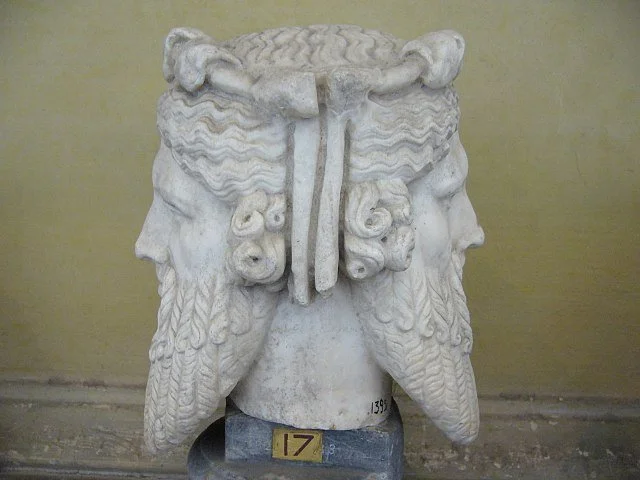
Janus is the Roman god of beginnings, endings, transitions, and time. He is the god of doors, gates, thresholds, and passages. Unlike many Roman gods borrowed from Greek tradition, Janus is fully Roman in origin. He stands at the start of things: the new year, a new project, a new phase of life. When Romans wanted to begin anything the right way, they turned to Janus first.
Janus is best known for his two faces. One face looks to the past. The other looks to the future. This makes him a god of balance and awareness, not just change. He reminds us that every beginning grows out of what came before. You cannot step forward wisely if you refuse to look back.
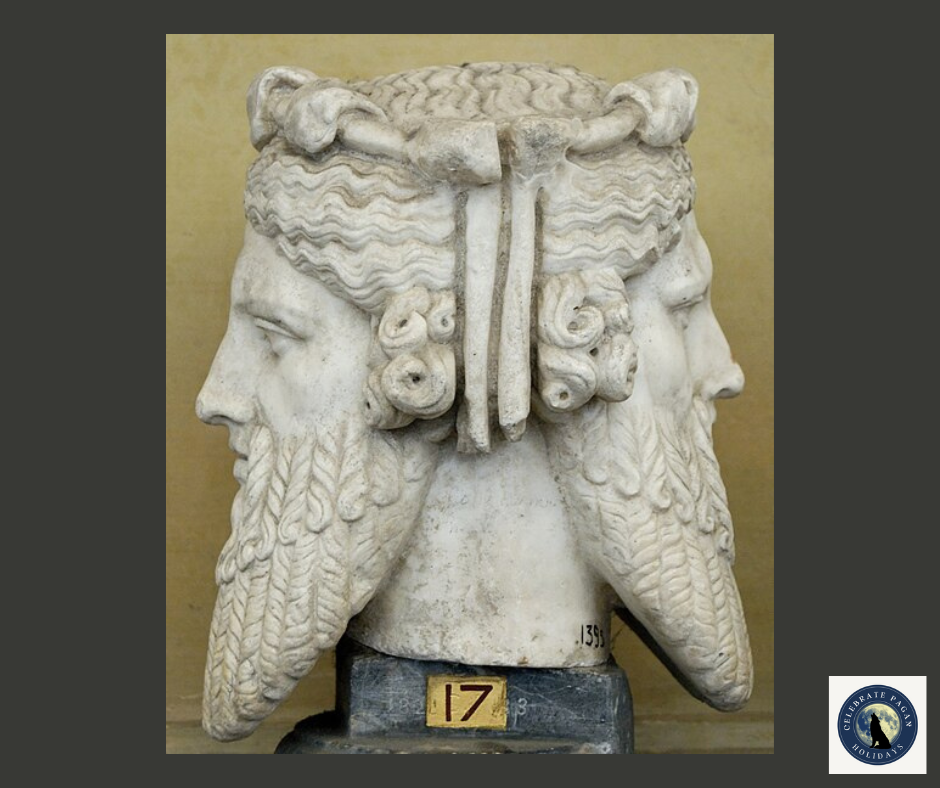
Janus - Statue representing Janus Bifrons in the Vatican Museums
Who is Janus?
Janus is an ancient Italic deity, likely worshipped before Rome became a republic or empire. His name is linked to the Latin word ianua, meaning door. This tells us a lot about his role. A door is not a place you stay. It is a place you pass through. Janus rules those moments of crossing, when one state ends and another begins.
Janus had no Greek equivalent. Because of this, Roman authors struggled to compare him to anything else. That uniqueness made him especially important in Roman religious life. He was not just a god among gods. He was the god who made all other actions possible.
Some consider Janus to be the first priest and the Father of Divination. Titles he earned by his ability to see the past and look into the future.
Janus is a god of symbols tied to everyday life. His power is practical, not abstract.
His two faces are his most famous symbol. They represent past and future, inward and outward, youth and adult, ending and beginning. This duality represents wisdom gained through experience. Janus does not forget what has happened. He uses it to guide what comes next.
Keys are another strong symbol of Janus. Keys open and close doors. They grant access. In Roman art, Janus often holds a key in one hand. This reflects his role as the keeper of thresholds. He decides what may pass and when.
Doors, gates, bridges, and city entrances were all sacred to Janus. Any place where movement happened from one space to another fell under his care. Even marriage and birth were seen as threshold moments that reflected Janus’ influence.
Fun Fact: We often think the month January is named after the God Janus when in fact, according to Roman almanacs, it is named after the Goddess Juno.
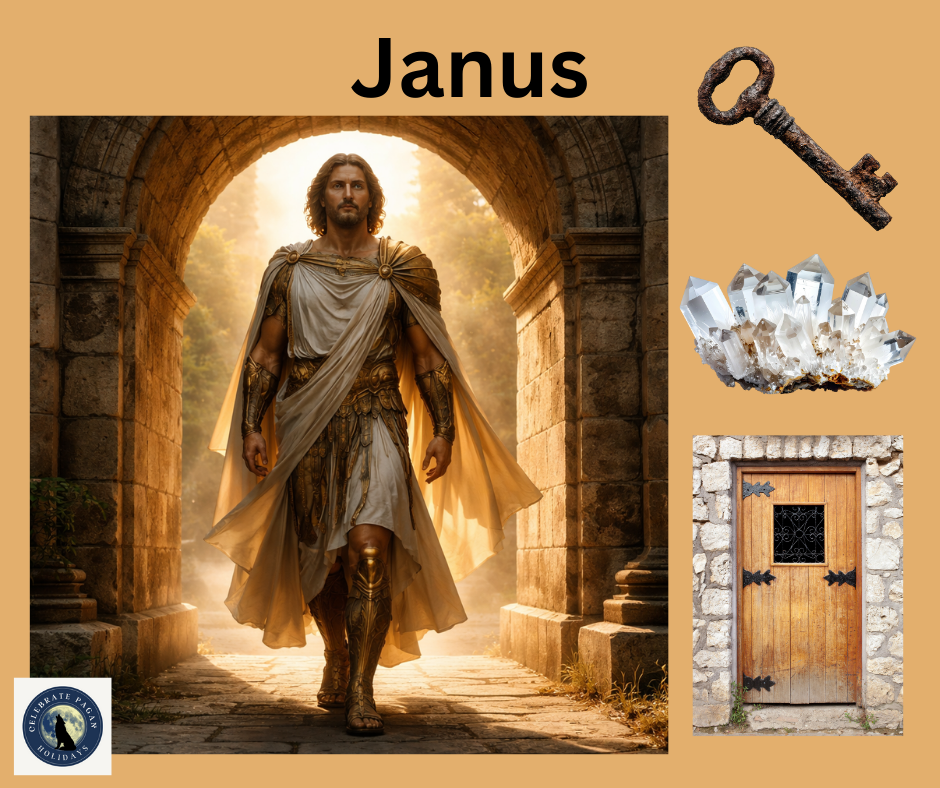
Archways, doors, keys and quartz crystals represent Janus.
Correspondences:
Symbols: Archway, Door, Key, Liminal spaces, New Beginnings
Culture: Roman
Abode:
Color: Bronze. Gold, White
Divination: Tarot
Number: 2
Elements:
Animals: Crane
Plants: Hawthorne
Planet: sunrise, New Moon
Sign: Capricorn
Crystal: Clear Quartz
Wood:
Consort: Camese, Jana, and Juturna
Deities: Hecate, Iana, Jupiter
Another deity of crossroads is Hecate. You can read about her in my article Hecate's Night: November 16.
Why Does Janus Have Two Faces?
Janus is portrayed with two faces. One is facing the past, and one is facing the future.
Some renderings show him with two of the same faces. Others portray a younger face and an older face.

Coin (denomination as) issued by C. Fabius Hadrianus in 102 BC, depicting the Roman god Janus and the prow of a galley with stork. Uncial standard. Rome mint. Rare; only five specimens known.
Position in the Pantheon?
While not a major God he was closely linked with Jupiter. Janus was very important in the daily life of people. Camese, Jana, and Juturna were the wives of Janus and he was the father of Tiberinus and Fontus.
Professor Donald Wasson states that it is possible that Janus actually did exist as a human man. According to legend, Janus immigrated from Greece to Rome where he ruled alongside an early Roman king named Camesus.
After Janus’ exile from Thessaly, he arrived in Rome with his wife Camise or Camasnea and children... He built a city on the west bank of the Tiber named Janiculum”.
What Temples are Dedicated to Janus?
There are several temples in the world that are dedicated to Janus. Some of these temples include the Porta Capena temple in Rome. The Temple of Janus Geminus was built 260 BCE in Rome after the Battle of Mylae. Neither of these temples is standing today.
How Can Janus Help Me Today?
Roman writers described Janus as the first god to be honored in prayers. Even when worshipping other gods, Romans often invoked Janus at the start. He opened the way so communication with the divine could happen clearly and without obstacles.
Transition, change, beginnings, endings, clear away negative energy, dreamwork, astral projection, divination (especially when done in early January)
As the God of changes and transitions, Janus should be a god you take time to worship.
Starting a new job or a business?
Giving birth or adopting a baby?
Moving or traveling?
Preparing for the next world?
Want to protect the doorway into your home?
Janus can help you in any magic that helps you with new beginnings as well as helping you escape from the burdens of your past.
Call upon Janus before doing divination practices.
If you are in sales, a trucker, or other professions where you travel for work then Janus is a good God to honor at the beginning or end of your day.
Janus Altar
You can set up a dedicated altar for Janus if you have a big transition coming up or you can set aside part of your daily altar for Janus.
Janus appreciates offerings of dried bay laurel leaves for incense, roasted lamb, pickled capers, wine, and pastries.
Greet the morning by honoring Janus. Make an offering of a pastry or roll and say…“Janus, I lift this food to you and put myself in your hands. I honor you at the beginning of this day and ask that you may favor me, my children, and our home.” Or something that meets your current needs.
How the Ancient Romans Celebrated Janus
Janus was honored daily in Roman life, but he also had specific festivals and public rituals.
The most important celebration of Janus took place on January 1. On this day, Romans exchanged gifts called strenae. These often included dates, figs, honey, or coins. The goal was to ensure sweetness, prosperity, and good fortune in the year ahead.
People offered prayers asking Janus to bless the coming year and keep doors open to success and health. Homes were cleaned before the new year to remove old energy and bad luck. This was not just practical. It was religious.
The Temple of Janus in Rome played a major symbolic role. Its doors were open during times of war and closed during times of peace. This made Janus a public marker of Rome’s state of being. When the doors closed, it was rare and celebrated.
Janus was also honored at the start of contracts, military campaigns, and political terms. His role was to ensure that actions began in proper order and with divine approval.
Great for Grimoire
How Do We Celebrate Janus Today?
There are many ways to celebrate Janus today.
One common way is to keep a coin in your pocket so that you can give it to someone when you cross paths with them. This tradition symbolizes the wish for good luck from Janus.
Written Intentions or Resolutions: Take some time to reflect on the past and look towards the future. What do you hope to attain this year? The act of writing down your intentions is be very powerful and can serve as a reminder when you face challenges.
Happy New Year
We often celebrate Janus on New Years Day. Janus does after all symbolize new beginnings. However, traditionally his holiday was on the Vernal Equinox.
It was a Roman tradition at the New Year to make an offering of honey, cakes, incense, and wine.
Another popular way to celebrate Janus is to eat a bowl of lentils on New Year's Day. This tradition symbolizes how life begins anew in the new year and also represents prosperity for the coming months ahead.
Romans did not take off from work on this holiday because they felt it demonstrated laziness and was a bad omen for the start of the year.
Author, Ame appreciates duality and likes to joke that she is 1/2 pagan and 1/2 Catholic due to her Native (Cree) and Italian heritage. She is a lifelong pagan, an environmental educator, and a licensed wildlife rehabilitator. Ame writes about honoring nature, animal spirit guides, crystals, and holidays. She also does our social media pages. Check us out on Facebook and Twitter.


Altars are a focal point for many religions. A place of sacred space. Creating an altar is one way for you to create and invite magic into your home.
For pagans, an altar is a place in your home where you will practice your religion. It is a place where you can connect with higher powers. Your alter is a living thing that enhances your spiritual walk.