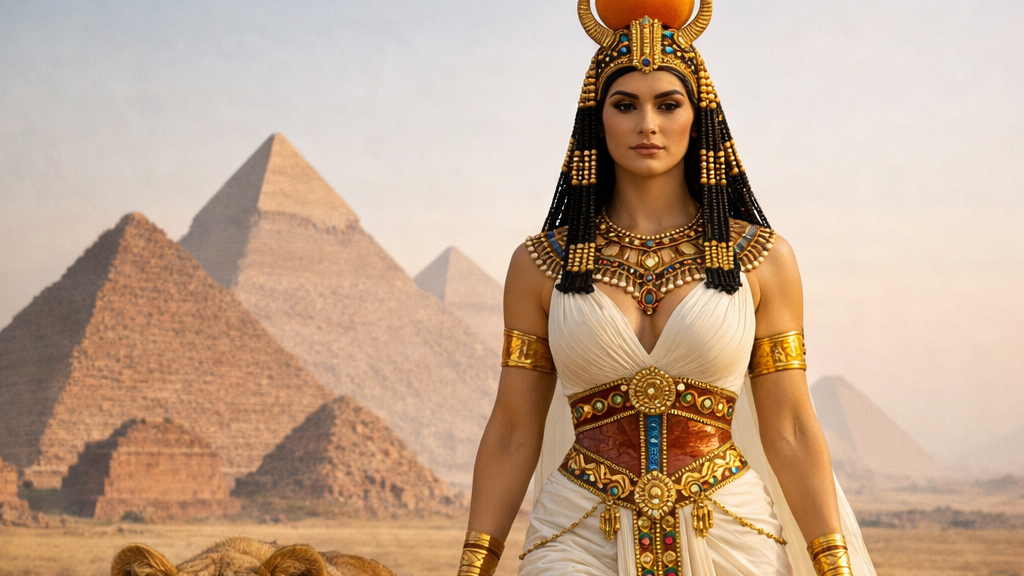
Sekhmet is the Egyptian Goddess of war, plague, chaos, and ironically also healing. Sekhmet has a complicated family history. Her name means, "She who is powerful”. She represents strength and leadership and is not afraid to fight for what she wants.
For those who practice neo-pagan Kemetic/Egyptian beliefs, Sekhmet represents strength and leadership. She is not afraid to fight for what she wants.
She is honored several times during the Egyptian calendar. For the sake of simplicity, we have her on our calendar for November. Keep reading to learn the days we honor her and what you can do to honor her.
Who is Sekhmet?
Sekhmet is the Egyptian Goddess of war, plague, chaos, and healing. She is also referred to as the Goddess of the hot desert sun and is a solar deity often depicted with a round disk symbol above her head.
Ra was angry that the people were neglecting him. Legend tells us that Sekhmet was created by Ra because He was angry that the people were neglecting him. Sekhmet was created as a bloodthirsty lioness who instilled fear and respect among the people. Controlling her, however, proved to be a challenge!
She roamed the land as a bloodthirsty lioness killing and maiming thousands. When Ra told her the people had learned their lesson, Sekhmet refused to stop killing. Ra tricked her by coloring beer red and leaving it out for her to drink. She became so drunk she passed out. When she awoke she no longer wanted to kill. Sekhmet then taught her priests to be healers.
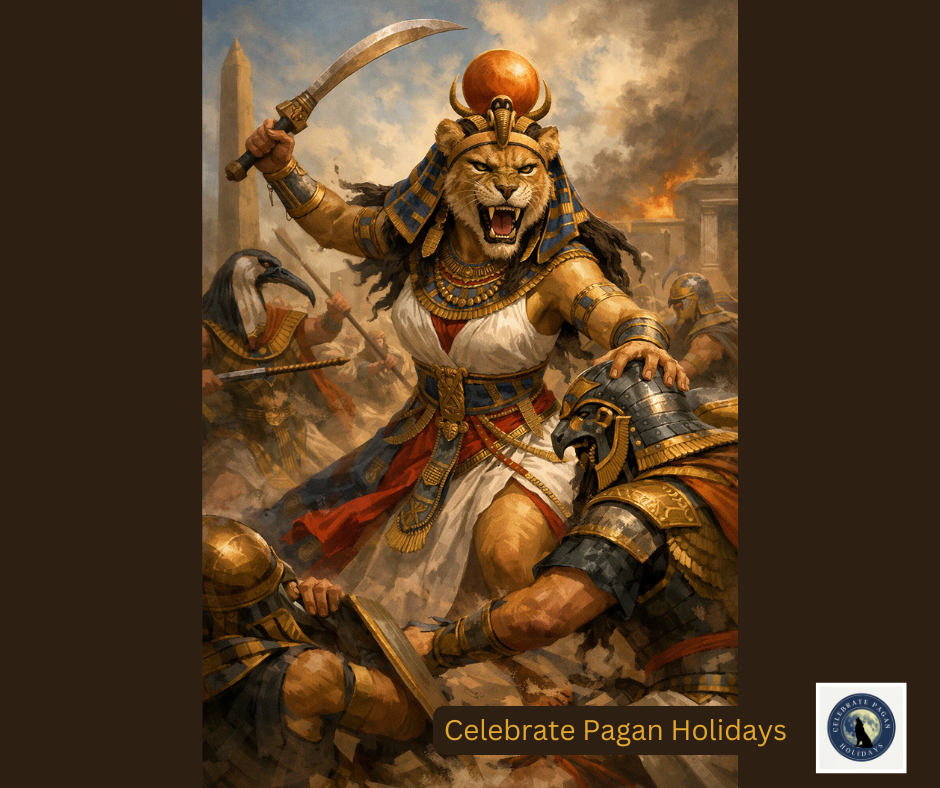
She roamed the land as a bloodthirsty lioness killing and maiming thousands.
Healing Goddess
Sekhmet is also the goddess of healing and the medical arts. She could heal diseases and avert the plague. There has been quite a bit of information recovered on Nedjemou her chief priest and other healers from her cult.
Ancient Egyptians were surprisingly advanced in medicine compared to other cultures of the time. There extensive process of mummification gave them a lot of knowledge about the human body.
The priests of Sekhmet, such as Ni-Ankh-Sekhmet about 2487 BC was recorded as curing the king's nose bleeds. Their approach of combining rigorous, often hereditary, medical knowledge with spiritual intervention, laid the groundwork for later Greek and Roman medicine.
During this period, food purity rituals that had once applied only to the king became a public health concern. Large solar festivals involved the sacrifice of many bulls for mass feeding, increasing the risk of foodborne illness. As a result, priests of Sekhmet emerged during the Fifth Dynasty (2494–2345 BC) with the responsibility of inspecting slaughtered cattle to ensure food safety.
By appeasing Sekhmet, her priests were believed to prevent illness and restore health, particularly through practices such as bone setting. Because of this dual role, the priests of Sekhmet are often considered among the earliest professional physicians of the dynastic period.
The Edwin Smith Papyrus, named after its founder, is believed to come from a tomb in the Theban Necropolis, a burial site in Luxor as early as 1650-1550 B.C.E. After the scroll was translated, scholars recognized it as an early Egyptian medical textbook. It provides instructions for treating a wide range of illnesses, injuries, and traumatic wounds. Each case follows a structured format that includes examination, diagnosis, prognosis, and recommended treatment. Most of the treatments described are practical and based on observation rather than magic.
As noted by scholars, “The Edwin Smith Papyrus follows a logical clinical approach to injuries that is not too dissimilar from the methodology used today.”
What Did Sekhmet Look Like?
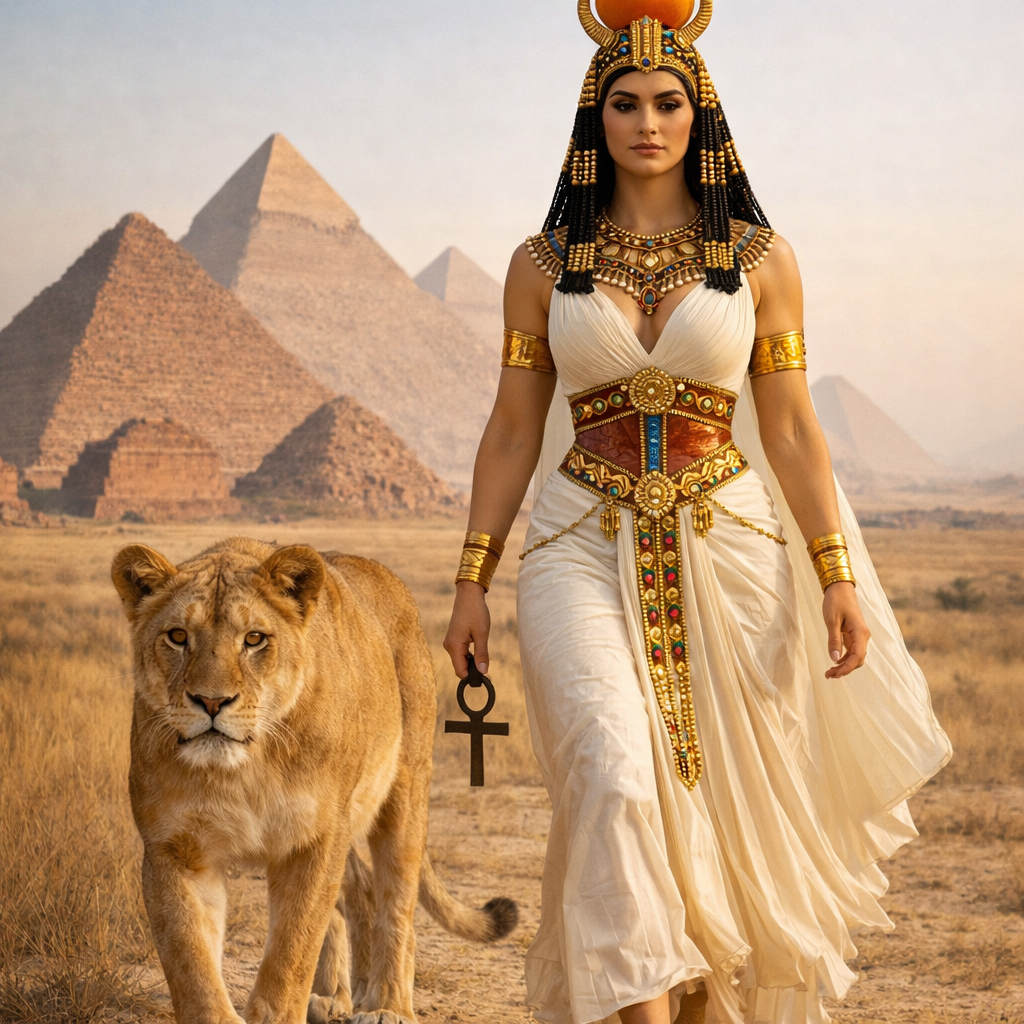
Sekhmet is represented by the head of a lioness, representing her ferocity. She is adorned with a sun disk and the cobra on her head, symbolizing her solar nature. She is often shown carrying an ankh or scepter. She is typically shown in red and gold, symbolizing blood, fire, and the desert sun and reflecting her dual role as destroyer and restorer. Sekhmet is sometimes depicted with a green face in ancient Egyptian art to symbolize renewal and regeneration, similar to the deity Osiris.

Sekhmet: Department of Egyptian Antiquities of the Louvre Museum. Wikimedia
Dates for Feast of Sekhmet
It is important to note that Sekhmet has considerable importance in Egyptian culture and worship. She has multiple days and feasts alone as well as shared with other Gods and Goddesses.
Some feasts celebrated are what is known as a feast of composite deities. This is where deities that are closely linked by relation or other factors are observed simultaneously.
Sekhmet has both kinds of feasts in her honor.
Here is a shortlist of days she is honored during the year:
August 12th – The Day of Sekhmet's repulsion of Set.
October 31st – This day is a composite deities feast – celebrated are Sekhmet, Bast, and Ra.
November 20th – The Day of Sekhmet and the Purifying flame. This is a time to renew spirituality and cleanse your altar. Anticipate increased clairvoyance during this time.
November 24th – This was the Day to give offerings to Sekhmet.
November 28th – This is another composite deities day. This day was to celebrate Sekhmet and Hathor. It is also referred to as the day of prolonging life and celebrating the goodness of Ma'at.
Check out my Pagan Celebration Calendar
Egyptian Astrology
She is the original form of the astrological sign Leo. If you were born between July 29 - August 11 or from October 30 - November 7 you are under Sekhmet in Egyptian Astrology.
Personality traits are ferocious defenders, telepathic, observant, and authoritarian.
Check out my video on Sekhmet. I am working to get some good content on YouTube and hope you subscribe to my channel.
Bastet VS. Sekhmet
There is some controversy over the relationship between Sekhmet and Bastet. Most Egyptologists believe they are different goddesses with some similar traits. The term counterpart or possibly sister is more apt. In my graduate course on Ancient Egypt my professor explained how they originated in different time periods and areas of Egypt. Sekhmet being worshiped primarily in Upper Egypt in Memphis and Luxor during the 18th and 19th Dynasties. Bast is a much older goddess popular in Lower Egypt. She first appears in the 2nd dynasty.
This is a fabulous book and I highly recommend it. Interesting and a fun read. Ancient Egypt: Everyday Life in the Land of the Nile
Other professors or Egyptologists see them as duo aspects of Ra. Both are considered his daughters. They function as a duality—the fierce, vengeful sun heat of Sekhmet versus the the mild, healing heat of Bastet.
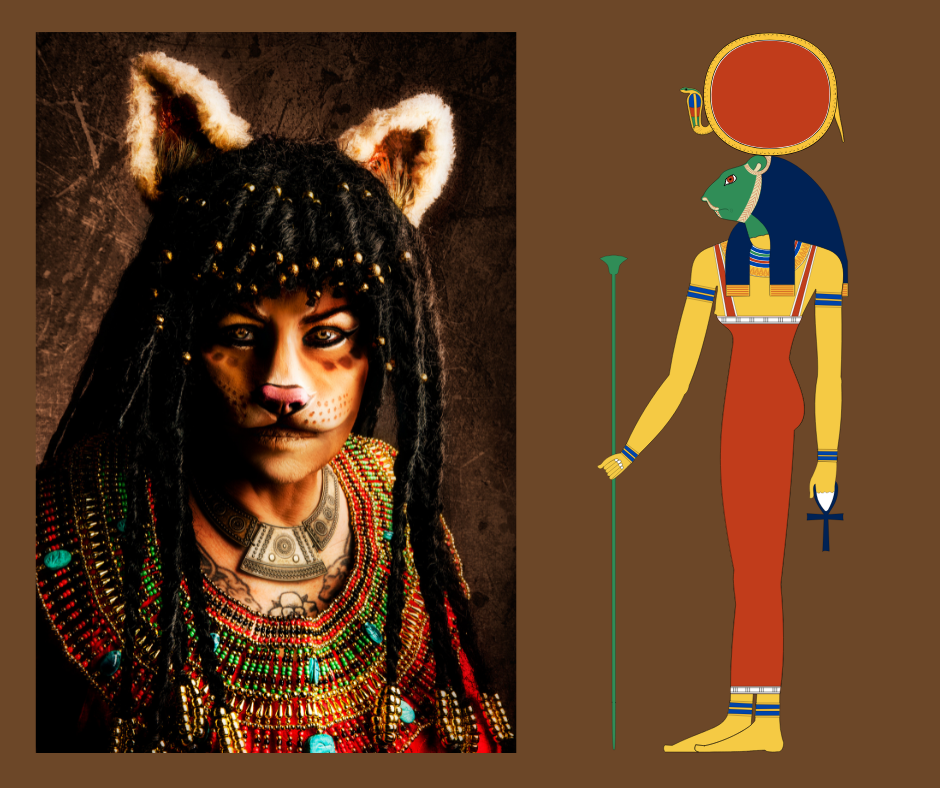
Two interpretations of Sekhmet
Ways To Celebrate Sekhmet Today
Feasting, drinking, singing, and music were all big parts of celebrating Sekhmet.
Popular foods included roasted goat or antelope, duck, fish, dates, figs, cucumbers, and pomegranates. Ancient Egyptians loved desserts and pastries, sweetbread, and honey cakes were common.
For adults, the drinking of red wine is a popular way to celebrate Sekhmet as she was also fond of drinking! For children or those that prefer a more family-friendly drink try pomegranate juice.
Dance - Feel your power. The ancient Egyptians loved music and dancing.
As the patron of healing and healers, Sekhmet is a wise choice to pray to when there is an illness in the family. In addition, learning more about herbal medicine and starting a medicinal herb garden are good ways to honor her.
Spend some time meditating today. I have found this a great way to get in touch with her. I like to focus on a red candle. Set an intention to open yourself to the feminine guidance of Sekhmet. You have the power within you!
Sekhmet was a force of female power. To honor her learn about famous women who fought hard for others’ freedoms such as Harriot Tubman, Frida Kahlo, Yuri Kochiyama… Donate money or goods to an organization in your community that empowers women.
Give offerings, prayers, and other forms of worship for Sekhmet
Offer some sort of performance for this Goddess. Dance, song, and artwork are all wonderful ways to honor her.
Stand up for someone who is being bullied
Recognize a doctor, nurse, or healer in your life in honor of Sekhmet
Meditate with the intention for empowerment
Altar To Sekhmet
On your altar place a representation of a lioness.
Incense scents are Dragons Blood, Frankincense, and Sandalwood.
Herbs and essential oils that she enjoys are orange blossoms, cinnamon, and cedar.
Crystals that will resonate with her power are bloodstone, garnet, carnelian, and ruby.
Take Away
The Goddess Sekhmet held a high level of importance in Egyptian society. Many people still view her as one of the most important goddesses to respect and worship today.
To work with Sekhmet is to accept responsibility—for your actions, your health, and your role in the wider world. Her lesson is simple and demanding: protect life, uphold justice, and never forget the cost of imbalance. Good advice in todays world.
Author, Ame, is a lifelong pagan and environmental educator. She took a graduate class in Ancient Egypt to renew her teaching certificate and is totally in awe of the culture and the Gods of the Nile.
Learn more about us on the Who We Are page


Have you ever wondered how ancient Egyptian goddesses can inspire us today? Bastet, the Egyptian cat goddess is more than just a figure from mythology - her energy is alive and relevant today. Even though thousands of years separate us from ancient Egyptian culture, Bastet’s values remain relevant. By embracing her principles, we can reshape and enrich our lives, learn to find balance, and give back to our communities.