
The wild boar is one of the more powerful spirit animals. Across cultures, the boar represents ferocity, courage, and a willingness to charge straight into challenges rather than shy away from them. In the natural world, wild boars are intelligent, adaptable animals that survive in a wide range of habitats—from thick European and American forests to scrublands, wetlands, and agricultural edges.
Because of this resilience, they symbolize determination, survival, and the power of confronting obstacles head-on. Their rooted connection to the soil also ties them to themes of grounding, instinct, and the wisdom found in the body rather than the mind alone. When the wild boar shows up as a spirit guide, it often signals a time to stop hesitating and act with courage and clarity, trusting your instincts and natural strength.
Throughout this article, we will review the wild boar as an animal, as a spirit guide, and we will share with you the ways pagans around the world view the wild board and how it’s incorporated into their culture.
The Wild Boar Represents:
● Fearlessness
● Bravery
● Control
● Command
● Generosity
● Abundance
● Courage
● Stubbornness
● Power
Motherhood
A Deeper Meaning of Representations
The Wild Boar is fearless, and won’t back down from a fight. Even if the predator or the threat is far greater than something it can handle, it will show no fear. When in face of grave danger, the Wild Boar will put up a fight even if the end is death, showing its extreme bravery. It symbolizes facing our consequences.
Pagans around the world embrace the Wild Boar as its spirit teaches us to face all challenges and gain control. By embracing the Wild Boar as a spirit animal we learn how to overlook our weaknesses and change them into strengths.
Boundaries are important to the boar. They encourage you to establish healthier boundaries and to communicate your needs in an assertive way. Don’t tolerant people who disrespect your limits. The wild boar will help you to stand up for yourself in situations where you previously might have given in.
The Wild Boar, living in a matriarchal society, has developed a sense of community and, when it comes to certain things, will gladly share with the rest of its companions. While the boar has many masculine qualities it also symbolizes motherhood and watching over our community. They teach us to love, nurture, and yes protect our children.
Not only does the wild boar teach us to face our problems but it instructs us to do so with honesty. Being truthful to yourself is also important.
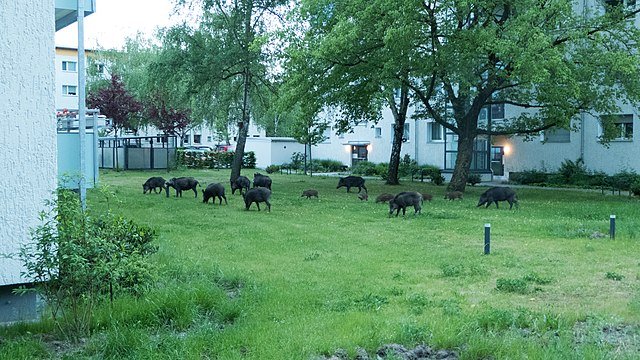
Wild boars in an urban area of Berlin, Germany. Photo by Leonhard Lenz.
Wild Boar Biology
The Wild Boar is a native animal to Eurasia and North Africa and has been introduced to the Americas and Australia in the time of colonization. This species is today, one of the widest-ranging mammals in the world. Due to adaptability to a large diversity of habitats, the Wild Boar has become an invasive species in many areas.
This has become a problem in many areas of the US. In 1493, Columbus brought pigs to the Caribbean islands and in 1539, Spanish explorer Hernando de Soto brought domestic hogs to Florida. The hogs reproduced quickly, escaped and became feral.
As of the early 21st century, 16 subspecies of Wild Boars are officially recognized. This species lives in a matriarchal society that consists of females and their young, whilst the male, when fully grown, usually live a solitary life and interact with female groups only during the breeding season.
In America, the main predator of the Wild Boars is the gray wolf, whilst in the east of Asia tigers fill in that spot. Though not mentioned as a predator, humans have hunted animals for ages.
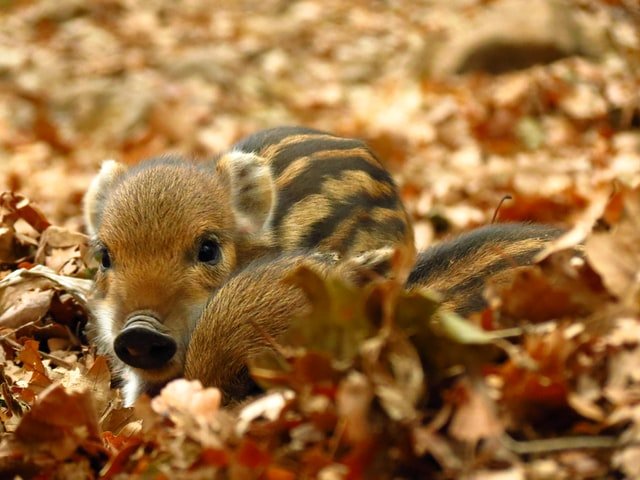
Baby wild boar piglets. Photo by Gabor Vereb.
Wild Boars Around The World
Native American
Even though the Wild Boar wasn’t a native to the Americas, it’s still somewhat present in Native American culture. The Native Americans celebrated the Wild Boar as a Teacher, a creature who offered them lessons in companionship joys.
They generally thought that the Wild Boar symbolized fearlessness and security, but also greed. Wild Boar as a totem represented caution against greed, egocentricity, and gluttony, apart from representing courage and bravery.
Also, one really important meaning of the Wild Boar found in Native American culture is its symbol of good mothering. Usually, it is a sign that you need love or protection.
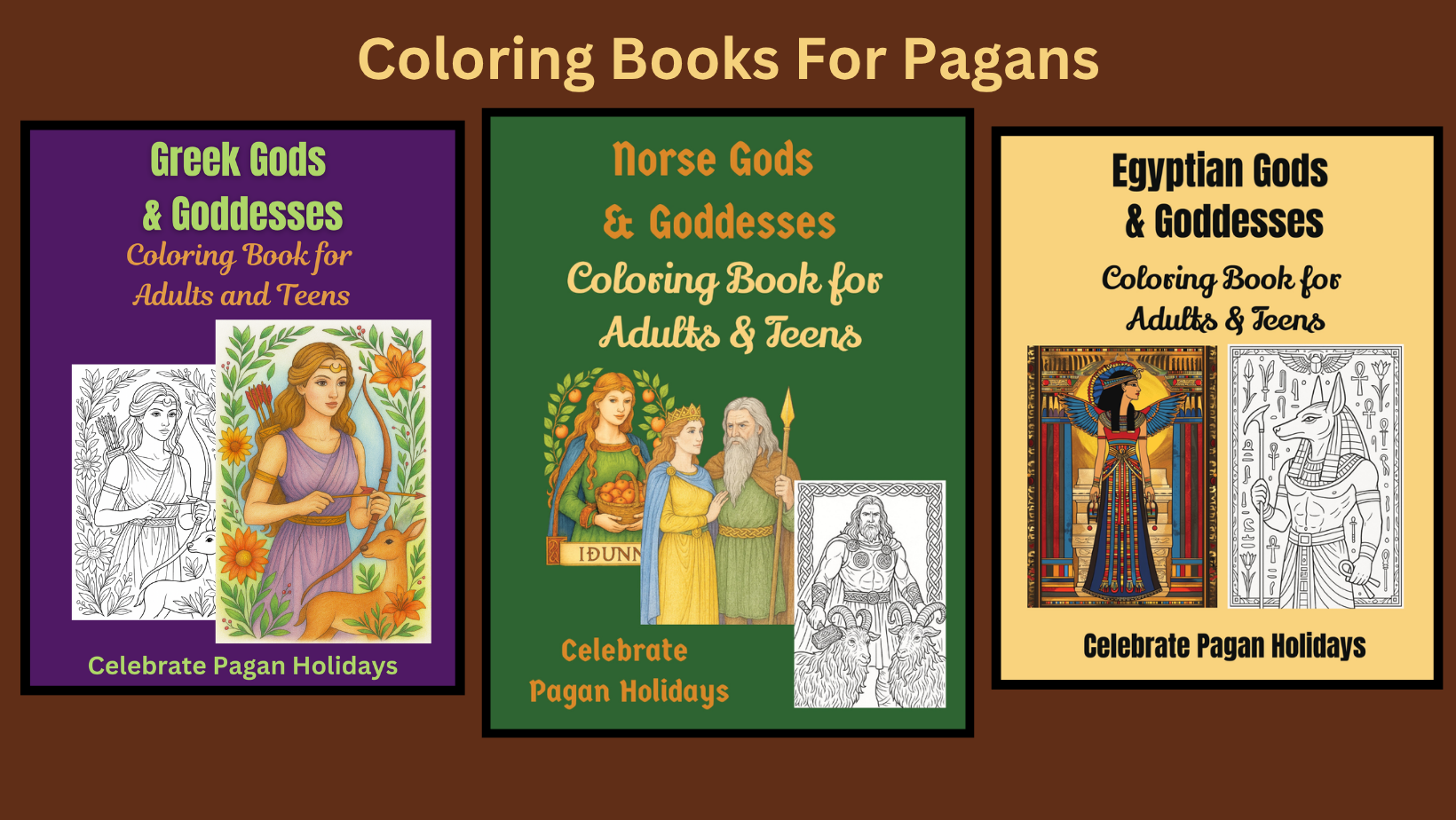
Beautiful images are great for relaxing or putting in your Grimoire. PDF downloads on our Resource page.
Norse
In the Norse religion and mythology, the Wild boar is utilized as a symbol for various scenarios. The vastness of meaningful representations the Norse found in Wild Boars provided us with the most diverse symbolic representation of all the cultures.
In one of the Norse Sagas, after a hero called Beowulf slain the great ogre Grendal, the Danish king presented him with a boars’ head, as they saw the boar as a fierce foe like the great ogre. The head of a Wild Boar represented the fierceness of battle. The Hamalt Fylking translated to “The Boars Head'', is described in one of the great Sagas, around the battle of Bravalla, where it’s referred to a battle formation that resembled the Boars head.
The Valkyries served warriors of Valhalla meat from a wild boar named Saehrimnir. After each feast, the board would magically come to life before it was served again.
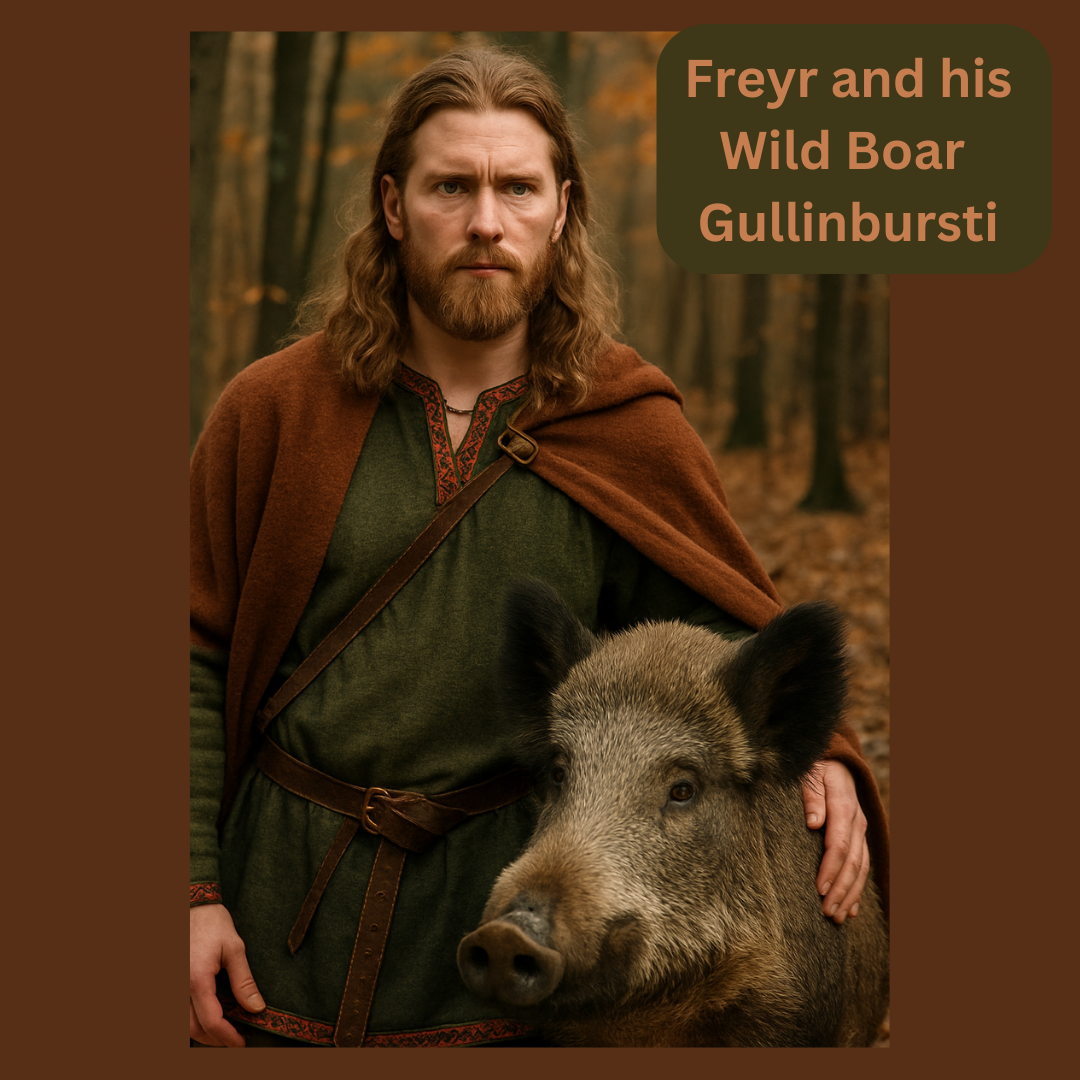
Two of the Norse deities had Wild Boar spirit animals. Freyr, the Norse God of fertility, possessed a Wild Boar named Gullinbursti, and it glowed in the dark and illuminated the his path. His twin sister, Freya had a boar named Hildisvini that she rides into battles.
Read our article on Norse Spirit Animals
Read Erik’s new edition of The Complete Guide To Become A Norse Pagan. Great for beginners and people who want to explore their spiritual growth on a deeper level. Full of hands-on activities.
Celtic
The Wild Boar was, to ancient Celts, known as a ferocious and aggressive animal. The Wild Boar was a Celtic emblem of War. Moccus is a Celtic god whose Roman equivalent is Mercury. He is the God of swine. Moccus was invoked as the protector of boar hunters and warriors. Boar meat was sacred among the ancient Celtic people.
For ancient Celts, the boar was known as a ferocious and aggressive animal and was a Celtic emblem of War. Excavations across Britain, Ireland, and France have found many boar artifacts. These weren’t just decorative; they were symbols meant to invoke the boar’s power and intimidate enemies. Similar motifs appear on shields, pottery, coins, and carved stones throughout the Celtic regions. On Iron Age coins, particularly from the Gaulish tribes, boars are common imagery, reinforcing their cultural importance and perhaps linking tribal identity to the animal.
Celtic mythology, represented fertility, wealth, warrior strength, stubbornness, and courage. The famous Irish myth of Diarmat and the Boar of Benn Fulbain represents the battle of forces of light and dark. The Wild Boars managed to kill over 50 of Diarmat's men and are a clear representation of darkness in this myth.
On the other hand, Wild Boars were also prophetic creatures that ushered in death and natural disasters. This negative portrayal can be found in various sagas, and usually, the otherworld tales often include boars in disguise, full of deception and disobedience. The Wild Boar is often the cause of the hero's death.
Slavic
The Wild Boar, in Slavic Native Faith, also known as Rodnovery, is associated with the God Svarozhits and it was his spirit animal. He was one of the deities associated with fire.
The Wild Boar as a spirit animal in Slavic culture was associated with fire and the sun. One of the Rodnovery myths that survived the ages, tells us a story of a great boar that would emerge from a lake in times of war when it is feeling threatened by that type of misfortune.
It had great white tusks and foam glistered from its mouth, wallowing in the mire with terrible agitation, showing itself to many people to avoid the bloodshed.
Read our article on Rodnovery Spirit Animals.
Chinese
In China wild boars and all swine represent good luck, financial success, happiness, and good relationships. In ancient China, leaders were buried with pigs to symbolize their wealth and bring them good luck in the next life. The pig is the twelfth animal of the Chinese zodiac.
Wild Boar as a Totem, Spirit Animal
People who embrace the Wild Boar as their totem are persistent in pursuing their goals. Moreover, they are stubbornly determined to achieve their dreams and will go the extra mile to achieve them. They encourage you to meet uncomfortable situations head-on.
As a spirit animal, the Wild Boar teaches us to be given to nature, to believe in miracles, not to hold grudges, and to be considerate. Kindness and will to put selfless service are perks of people who align themselves with the Wild Boar spirit animal.
Wild Boars in Dreams
When a Wild Boar appears in your dream, it is usually an indication that there is an argument pending, more severe than usual, most likely with someone close to you. In other words, you need to approach situations clear-headedly because bad ending arguments can end in long-term separation.
When a Wild Boar is envisioned in dreams, it is seen as an indication of a warrior spirit. Isolt, a great warrior, dreamed of the demise of a great boar, which forewarned him of his death.
Careers
Some people think swine are lazy but they are hard-working, focused, and honest. People who relate to the wild boar often are drawn to careers in construction, finance, and engineering. Other options include professions that require toughness and strategic thinking, such as law enforcement or politics.
Careers that align with the spirit of a wild boar often involve working with animals, nature, and a sense of resilience, such as wildlife management, veterinary roles, and conservation work.
Updated November 26, 2025 by Eric Olsen, CPH’s Norse expert. Learn more about Who We Are here.
Original Author, Marko Rajkovic, is from Serbia, Europe, specializing his pagan path in his Native Slavic Faith called Rodnovery and dwelling into Wiccan solitary practices. He loves outdoor adventures, hiking and has lots of animal friends.

Raccoon is a powerful spirit guide and has many lessons to teach us. They are an interesting mix of intelligence, resourcefulness mixed with a general penchant for getting into mischief.