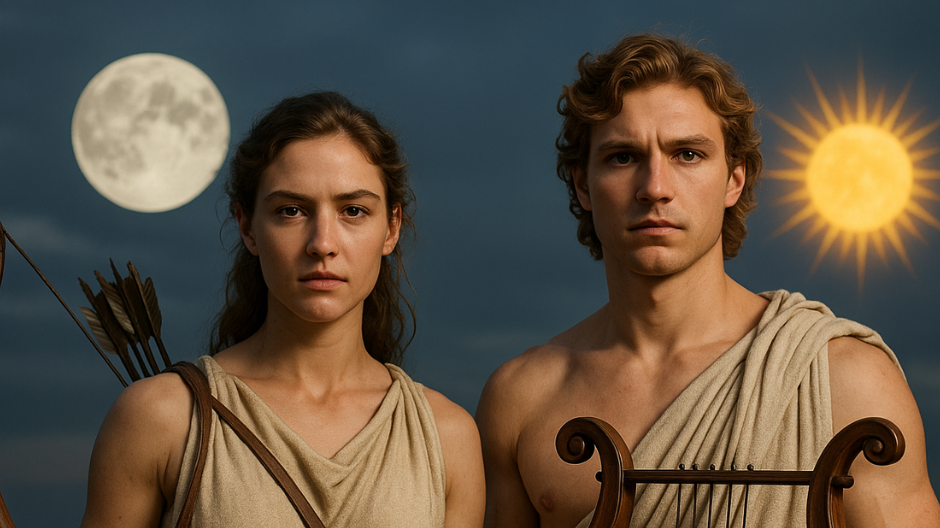
Artemis and Apollo have fierce family loyalty. The illegitimate children of Zeus, born to an ostracized single mother. Protective of their family they were often vengeful when they felt wronged. Like most siblings they are known to have their disagreements and even rivalries, but their twin bond was strong and they had each others backs. Both became very powerful and distinct deities.
In this article, we are going to look at their origin story, family drama and how their childhood shaped them.
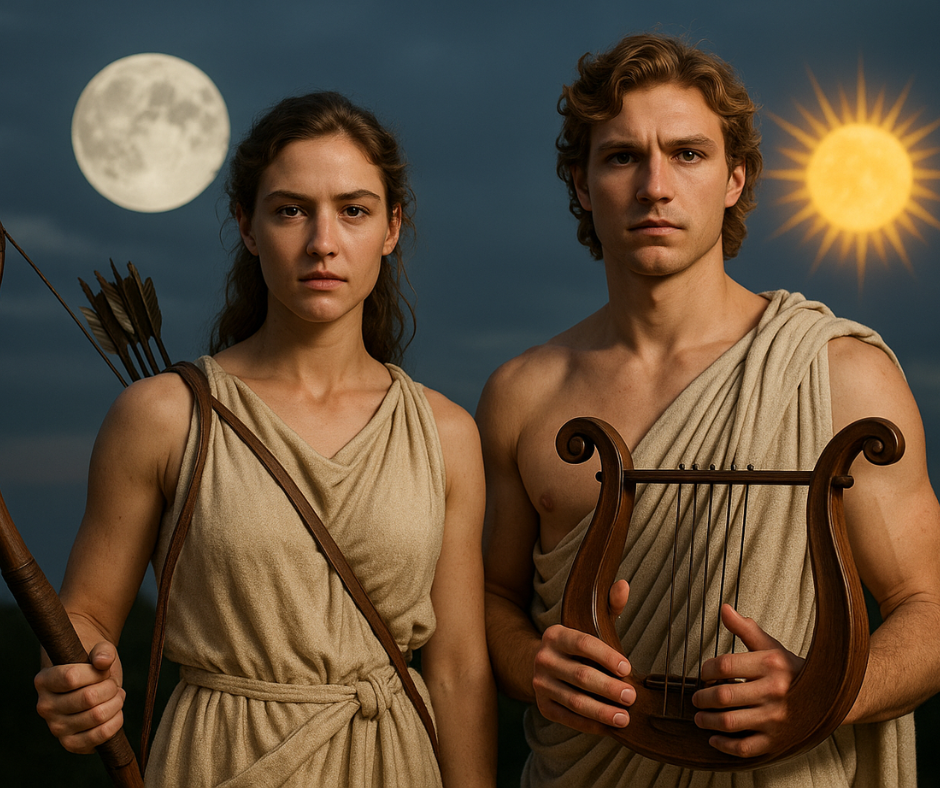
The Wonder Twins: Apollo and Artemis
The Birth of Apollo and Artemis
Their mother Leto was the daughter of the Titans Coeus and Phoebe. The Titans were the original Greek deities and the twelve children of the primordial deities Uranus (Sky) and Gaia (Earth).
Zeus, a suave ladies man, swept Leto off her feet into an illustrious affair. Leto became pregnant as a result. The problem was Zeus’s wife, Hera, was pretty pissed off and vows to make Leto's life miserable. She had her pursued without mercy and ordered all lands to shun her and deny her shelter. Leto was forced to wander in search of a place to safely give birth.
She found refuge on the island of Delos, which was not yet connected to the earth and therefore not subject to Hera's curse. In the Homeric Hymns, Delos actually bargains with Leto, worried this future god will look down on her barren shores and Leto swears that Apollo will honor the island above all others. There, she gave birth to Artemis first, and then Apollo.
During the birth, Hera still interfering, bonded Eileithyia, the goddess of childbirth, preventing Leto from having an easy and painless labor. With Eileithyia out of commission, Artemis born first, was the one to help her mother deliver her twin brother, Apollo, establishing her role as a birth goddess from her very first moments. This early incident instilled in Artemis the protective nature that would define her.
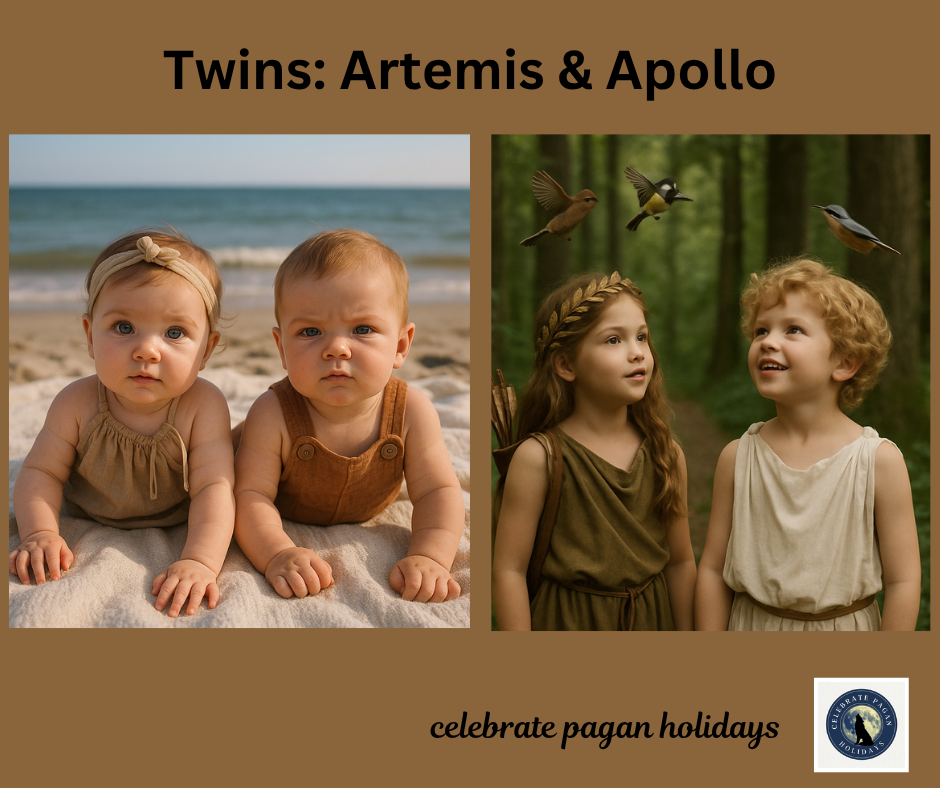
Apollo and Artemis children.
Childhood of Apollo and Artemis
I wish I could say the children had a lovely childhood. But Leto had to continue to hide due to Hera's wrath. Hera's jealousy toward Leto meant the twins grew up understanding the need for vigilance and mutual protection. The young goddess and god developed their archery skills and powers.
When they were young, the giant Tityos attempted to rape Leto, but Apollo and Artemis intervened and killed him.
The teens were sent to Olympus and Zeus for training. During this time Artemis asked for eternal maidenhood, so no marriage will ever tie her down. She asks for a bow and arrows and a short, knee-length tunic she can actually run and hunt in. She asks for the mountains as her domain, and for a band of young nymphs as her hunting companions. Zeus laughs, delighted, and grants all of it and more.
Artemis is asking for freedom, wilderness, movement, and independence. She's designing a life at the edges of the settled world, and she's doing it on her own terms.
While Apollo would become associated with civilization, music, and rational thought. He plays the Lyre and writes poetry.
The twins are both associated with archery, sudden death, and divine punishment. Yet their approaches differed significantly: Apollo's justice was often calculated and systematic, while Artemis's was swift and instinctual, reflecting her wild nature.
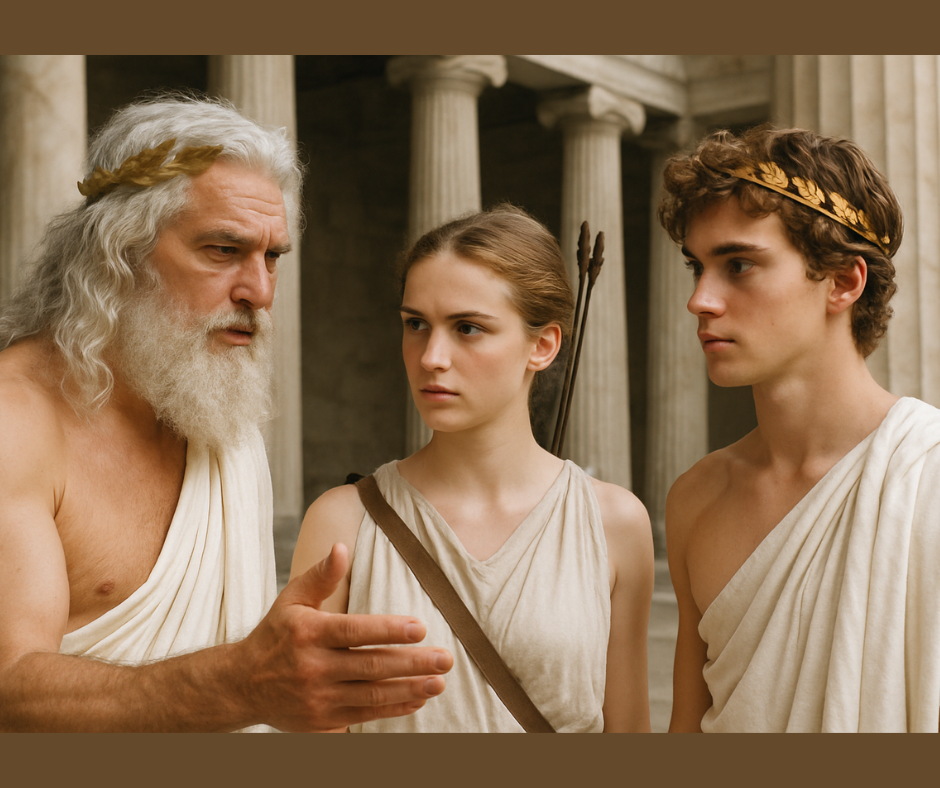
As teens, Artemis and Apollo went to Olympus to spend time with their father Zeus.
Queen Niobe and Leto
Leto finally settled in Thebes to spend the rest of her life. There, Niobe, the arrogant queen of the city, said that she was superior to Leto, because Niobe had given birth to fourteen children, seven male and seven female, instead of two.
Leto told her children what was said and Apollo and Artemis were so insulted, that they took revenge, killing all fourteen of Niobe's children. Apollo shoots down Niobe's sons, Artemis her daughters. Defending their mother is the twins' first instinct, and they act as one.
When Niobe discovered what had happened, she burst in great grief. She then asked Zeus to show mercy to her and turn her into a stone, so that she would no longer suffer.
Leto is praised for raising such divine children.
The great Greek writer Homer penned these words in part saying:
"Then, in a goblet of gold, sweet nectar his father Zeus presents him,
making his dear son welcome; and Leto the lady is gladdened,
seeing that she has brought forth so mighty a son and an archer.
Hail and rejoice then, Leto the blessèd, for glorious children
you bore, lordly Apollo and Artemis shooter of arrows"
Artemis and Apollo had fierce family loyalty. Protective of their family they were often vengeful when they felt wronged. In this video we are going to look at the family drama and how their childhood shaped them as well as ways to honor them today.
Artemis and Orion
At times the twins did have normal sibling conflict. Artemis developed a friendship with the hunter Orion and they often spent time in the woods together. Some sources suggest that Artemis began to feel genuine affection for him, perhaps even love, which created a crisis for a goddess who had sworn eternal virginity.
Apollo, observing his sister's growing attachment to Orion, became concerned that she might abandon her vows.
In the most tragic version of the story, Apollo devised a cruel test. Seeing Orion swimming far from shore, appearing as just a dark speck on the water, Apollo challenged Artemis to hit the distant target with her arrows, claiming she could never make such a difficult shot. Artemis, proud of her archery skills and unwilling to back down from a challenge, took careful aim and shot perfectly - only to kill Orion.
Devastated by her brother's trick and her own unwitting participation in Orion's death, Artemis placed the hunter among the stars as the constellation Orion, where he continues his eternal hunt across the night sky. This story reveals the tragic cost of her divine nature – her very powers and commitments could prevent her from experiencing mortal love without destruction.

Cosmic Balance
Together, Artemis and Apollo represent cosmic balance and justice that goes beyond simple right and wrong. They complement each other and demonstrate how different approaches to justice can work in harmony to maintain order.
Artemis and Apollo can be good to call on when you are struggling with work life balance.
Their protection of Leto from Tityos wasn't just familial loyalty but cosmic justice. Tityos represents the kind of chaos that threatens both divine and natural order. His attempted assault on Leto was an attack on sacred motherhood and divine authority.
Artemis rules everything outside the walls: the forest, the hunt, wild animals, the dangerous thresholds of a young woman's life. Apollo rules the ordered center: the city, music, law, prophecy, the founding of colonies, the purification of pollution. She governs the margins; he governs the middle. That polarity, untamed nature on one side, human order on the other, is the axis the whole pair turns on, and it maps onto their childhood choices almost perfectly. The girl who asked for the mountains got the wild. The boy who claimed the lyre and the oracle got the city.
Gender Role Reversal
Another interesting thing about our favorite twins is they have a gender role reversal. Apollo, while male, is traditionally associated with both masculine and feminine principles. He's a god of healing and purification as well as plague and destruction, of gentle music and poetry as well as deadly arrows.
Artemis, while female, embodies both nurturing protection and fierce destruction, maternal care and virginity. She is strong and independent. Artemis is the hunter, the fighter, the one who roams the mountains with a weapon and a pack of hounds.
Together, they transcend simple gender roles in society. The daughter takes the "warrior" role; the son takes the "artist" role.
They function as a team.
Author: Our Founder, Ame is a lifelong pagan, an environmental educator, and a licensed wildlife rehabilitator. Her journey began with her aunt taking her for walks in the woods to identify plants with magical qualities and a great grandmother who told her the stories of her ancestors.
I have had SO MANY spam posts on the website, I have turned off comments. But I do want to hear from you. Email at celebratepaganholidays@gmail.com or comment over on YouTube.
Read more About Us here

Samhain was a principal holiday for the ancient Celtic people and it remains an important celebration for pagans in modern times. Samhain marks the end of the agricultural season and the beginning of a New Year.
During Samhain, we honor our ancestors, thank the livestock for all they have given us, and enjoy the fall harvest. It is a wonderful holiday to bring families closer together.