
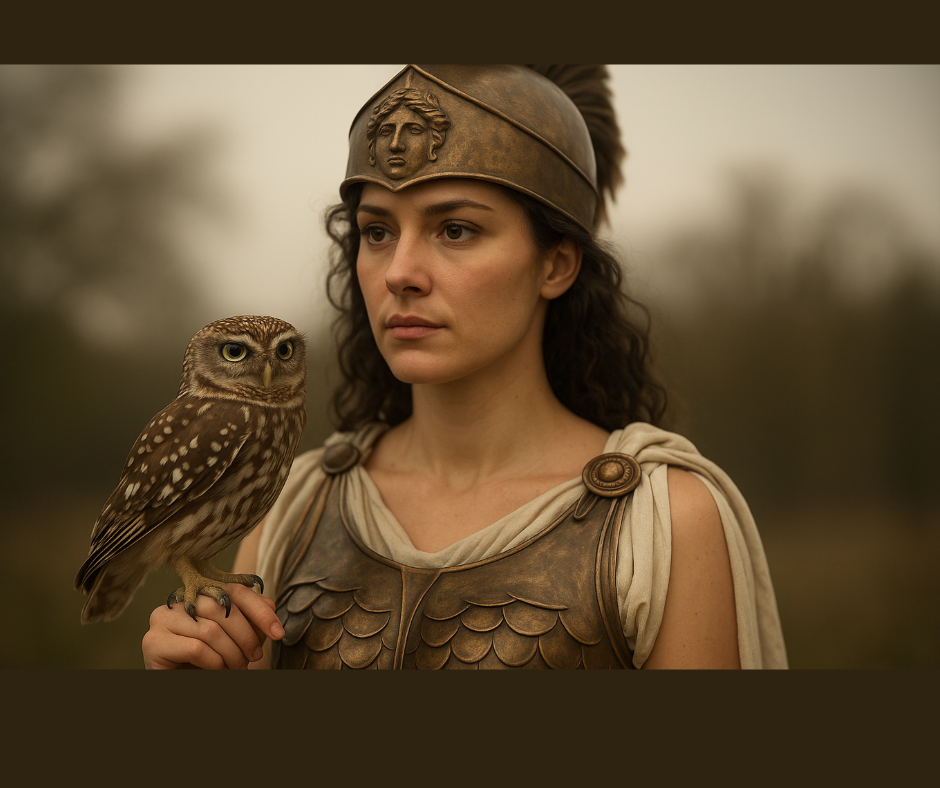
Athena, the goddess of wisdom, warfare, and crafts. Born from her fathers head, remained a virgin, and was a military leader. Her presence is commanding. Typically clad in armor, bearing a shield, and often joined by an owl, she represents clear thinking, justice, and courage. As one of the most revered Olympian deities, Athena continues to inspire us today as we seek guidance in decision-making and creative expression.
This article will discuss who she is, her symbolism, and how we can honor her today.
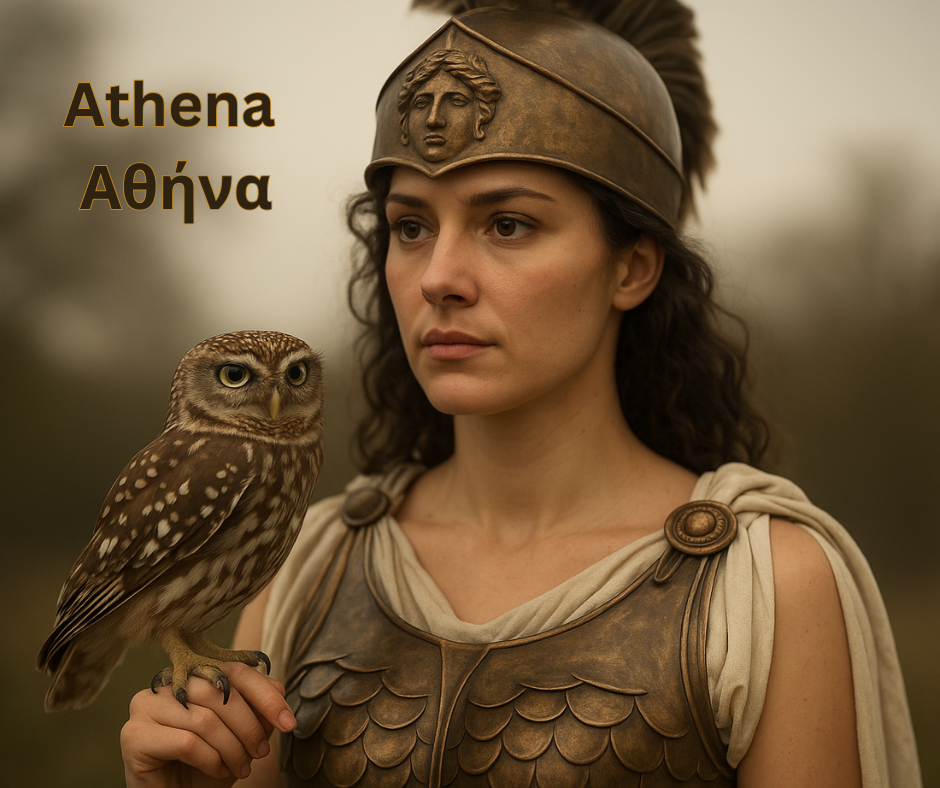
Athena, the goddess of wisdom, warfare, and crafts.
Correspondences
Symbols: Owl, Olive branch, Aegis, Gorgoneion, spear, Corinthian helmet, shield, spindle and distaff.
Culture: Greek (Hellenic)
Abode or Planet: Mount Olympus, home of the gods, The Acropolis of Athens is her earthly seat.
Day: Thursday. In the old Athenian calendar, the third day of each lunar month was linked to Athena.
Color: Gold, silver, gray
Divination: Bird augury and omens
Elements: Air
Animals: Horse, Little Owl, Rooster, Snake
Flowers: Geranium, marigold, and Olive blossom
Herbs: Lavender, Olive leaf and oil, Thyme
Stones: Lapis lazuli and sodalite for wisdom, Tiger's eye for courage and strategy.
Wood: Olive, her sacred tree
Intelligence Over Strength
While we often picture her in battle Athena is not known for cruelty. Her power comes from strategy and intelligence, not brute strength. She preferers peaceful resolution and only advocates war when justice demands it.
Unlike many Greek deities who were prone to drama and impulsive actions, Athena is composed and clear-headed. She was frequently consulted by other gods and heroes for advice and judgment. This is why she is a symbol of fairness and wise leadership.
Athena’s Unique Birth
Athena’s birth is one of the most unusual and memorable events in Greek mythology. She did not have a mother in the traditional sense. Instead, she sprang fully grown and fully armed from the forehead of her father, Zeus, the king of the gods.
The story goes like this: Zeus was a bit of a ladies man, and he had an affair with the Titaness Metis who was known for her wisdom. Zeus swallowed her whole when he found out she was pregnant with Athena. OK a tad weird.
Zeus did this because of a prophecy that said any child born to Metis would surpass Zeus in power. Fearing this, Zeus tried to avoid the prophecy by swallowing her. Metis stayed inside Zeus and made armor and a helmet for her unborn daughter, causing Zeus to have a terrible headache.
The blacksmith god, Hephaestus, struck Zeus's head with an axe to relieve his pain. Out sprang Athena, dressed in shining armor and ready for battle. The Homeric Hymn to Athena (Hymn 28) describes her birth as causing the great Mount Olympus to shake.
Her sudden and dramatic emergence symbolizes the birth of wisdom showing her role in divine intellect. Because she was born from Zeus alone, without being raised by a mother, Athena is often described as her father's favorite and closest ally among his children.
Check out my website store for pagan resources

Athena and Odysseus
The Odyssey is in many ways the story of Athena's care for a mortal she admires. She is the divine patron of Odysseus, valuing him for his sharp mind. She pleads his case before Zeus so he can finally return home (Homer, Odyssey 1), guides and protects his son Telemachus while often appearing in the disguise of a man named Mentor, and helps Odysseus plan his return to Ithaca, meeting him disguised as a shepherd (Homer, Odyssey 13). Their partnership is one of mutual respect between goddess and mortal.
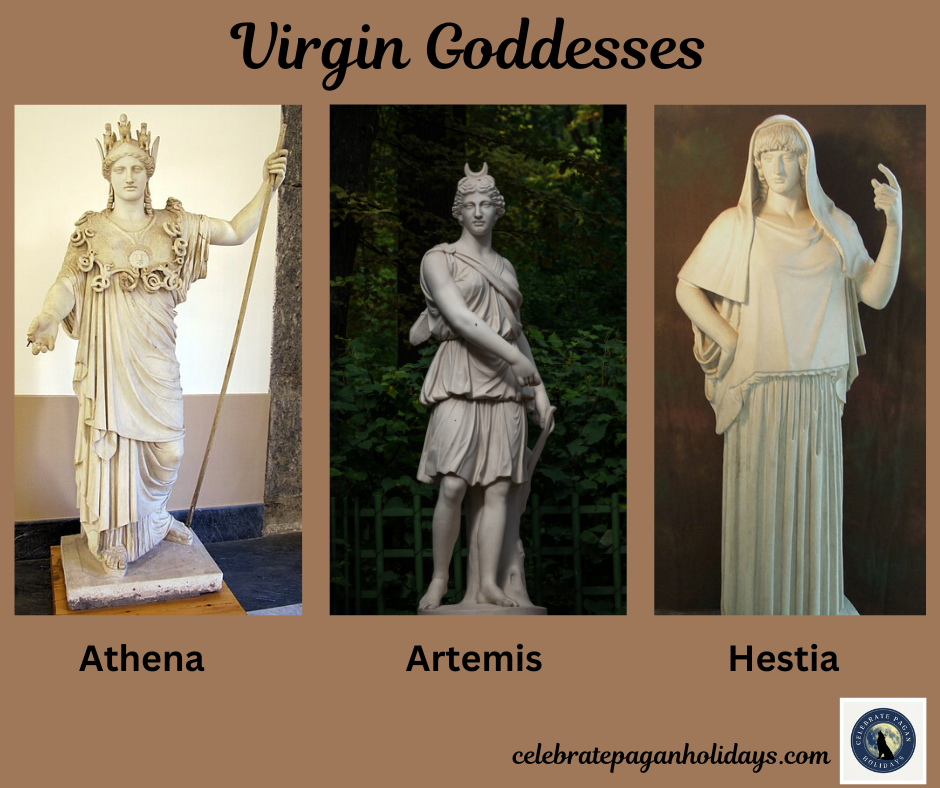
The three virgin goddesses in the Greek pantheon are Athena, Artemis, and Hestia.
Virgin Goddess
The three virgin goddesses in the Greek pantheon are Athena, Artemis, and Hestia. These goddesses all swore vows of celibacy. Goddesses often choose virginity because it gives them more power and independence. Like Artemis and Hestia, Athena choose celibacy because she valued her independence. She is not defined by her relationships, but rather by her own power and wisdom.
I have a video on Artemis here
Athena's worship stretches back to the Bronze Age, with evidence suggesting she was revered as early as 1500 BCE. She was originally the Aegean goddess of the palace, who presided over household crafts and protected the king. Archaeologists also argue that the Minoan snake goddess figurines are early representations of Athena. Athena was either an owl herself or a bird goddess in general. In Homer’s epic The Odyssey, she takes the form of a sea-eagle. The cult of Athena may have also been influenced by those of the Near Eastern warrior goddesses, Inanna.
While we don't know the exact origin of Athena we do know that the ancient Greeks, Persians and Egyptians were accomplished sailors. They were trading, fighting and exchanging ideas for thousands of years. Long before they became the modern countries we know today.
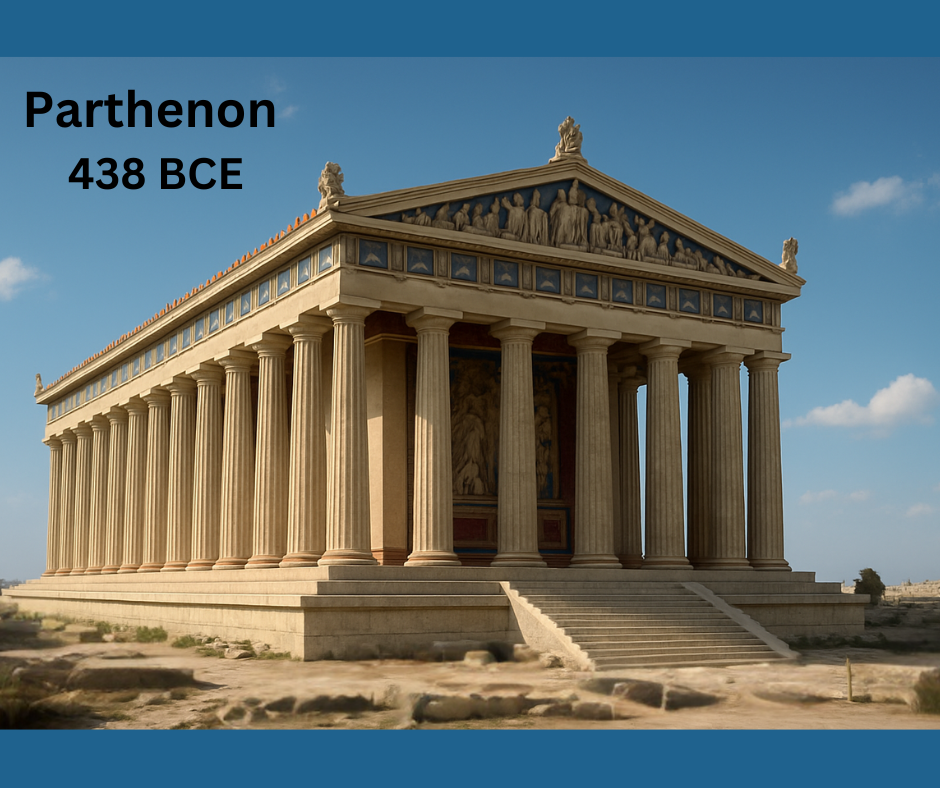
The Parthenon would have been a vibrant and colorful back in 438 BCE
The Parthenon
The Parthenon would have been a vibrant and colorful back in the day, not the stark white we see today. Dedicated to the goddess Athena it served as a focal point for religious ceremonies and festivals and was a place people would leave offerings.
It even had a room known as the opisthodomos, which was used to store the city's treasury. This specialized chamber functioned securely as the city's treasury to house public funds, tribute from the Delian League, and valuable religious offerings
On a fun note, there is a full sized replica in Nashville, Tennessee, which functions as an art museum. It’s owned and operated by Metro Nashville Parks & Recreation.
Panathenaea Festival
The Panathenaea was the most important religious and social festival in ancient Athens, held to honor the city's patron goddess Athena. It took place every year in mid-summer and this year will be August 8 - 13, 2026. This grand festival included athletic competitions, musical contests, and a magnificent procession through the city.
To honor Athena as the patron of crafts and skills special woven robe called a peplos was prepared by young Athenian women over months to adorn or present to the statue of Athena.
On the final major day, a massive procession traveled from the Dipylon Gate along the Panathenaic Way up to the Acropolis. Priests, maidens carrying sacred baskets, musicians, horsemen, and sacrificial animals led the way.
You might celebrate this time to hold a ritual, light candles in her honor, or make a meal featuring Greek foods.
Minerva
Minerva is what the Romans called Athena when they adopted her into their pantheon. Minerva preexisted as an Etruscan goddess but the Romans gave her more status as a goddess of wisdom, learning, and peaceful crafts in Roman culture. They tend to downplay Athena's more warrior characteristics.

Spirit Animals
The owl is her most famous companion, and if you know me at all you know that I'm an environmental educator and wildlife rehabilitator. So yes, I love the owl symbolism. Her owl represents wisdom and the ability to see clearly in darkness – both literally and metaphorically. Ancient Greeks believed owls could see what others missed, making them perfect symbols for a goddess who values insight and understanding.
Her owl, the little owl species is also known as the owl of Athena and is a common species in the warmer regions of Europe. They have a distinctive serious face due to their eye shape. Unlike many owls, Little owls sometimes hunt during the day.
Snakes are also associated with Athena and often seen on her armor. Near her temples a guardian serpent was often kept because snakes symbolize regeneration, healing, and earth wisdom.
The Contest for Athens
Both Athena and Poseidon wanted to be the patron of Attica. To win the people over, each gave a gift. Poseidon struck the rock of the Acropolis with his trident and produced a spring of salt water (some versions say a horse). Athena planted the first olive tree. The gift of the olive was judged the more valuable, since it gave food, oil, and wood, and Athena won. The city was named Athens in her honor.
The olive tree symbolizes peace, prosperity, nourishment, and enduring strength. Even today, olive branches are universal symbols of peace, carrying forward Athena's legacy. The historian Herodotus records that in his day people still pointed to the salt spring and the sacred olive tree on the Acropolis as proof of the story (Herodotus, Histories 8.55).
Grow your own olives! An olive tree makes a fabulous houseplant.
Give your tree a spot in front of a south- or east-facing window. Add an artificial grow light if your window doesnt get at least 6 hours of sun. Use a pot with large drainage holes to prevent root rot. Check the soil depth with your finger; if the top 2 inches feel dry, water deeply until it flows out the bottom.
All about Athena, Greek goddess of wisdom, and ways we can honor her as modern pagans.
Honor Athena Today
In today’s chaotic and information-heavy world, Athena’s presence feels more relevant than ever. For women and men alike, she stands as a model of independence and strength. She reminds us to slow down, think clearly, and act justly. She supports those who seek knowledge, not for the sake of pride, but to bring peace, fairness, and strength to the world around us.
One of the most authentic ways to honor Athena is to embody her virtues. Strive to be fair in your judgments, courageous in your choices, and wise in your speech. Whether you are working on a conflict resolution, studying a complex topic, or crafting something by hand, doing so with integrity is a sacred act in her name.
Crafts
Engage in making things with your hands. Athena is the goddess of both intellectual and manual crafts. She is the patron of potters, carpenters, metalworkers, and above all weavers and spinners. Her title Ergane, "the worker," reflects this side of her.
Take up knitting, woodworking, or writing. She delights in minds and hands that are active and intentional.
Since Athena values both theoretical knowledge and practical application, combining study with hands-on projects or volunteering. Do a deep dive into subjects that matter to you.
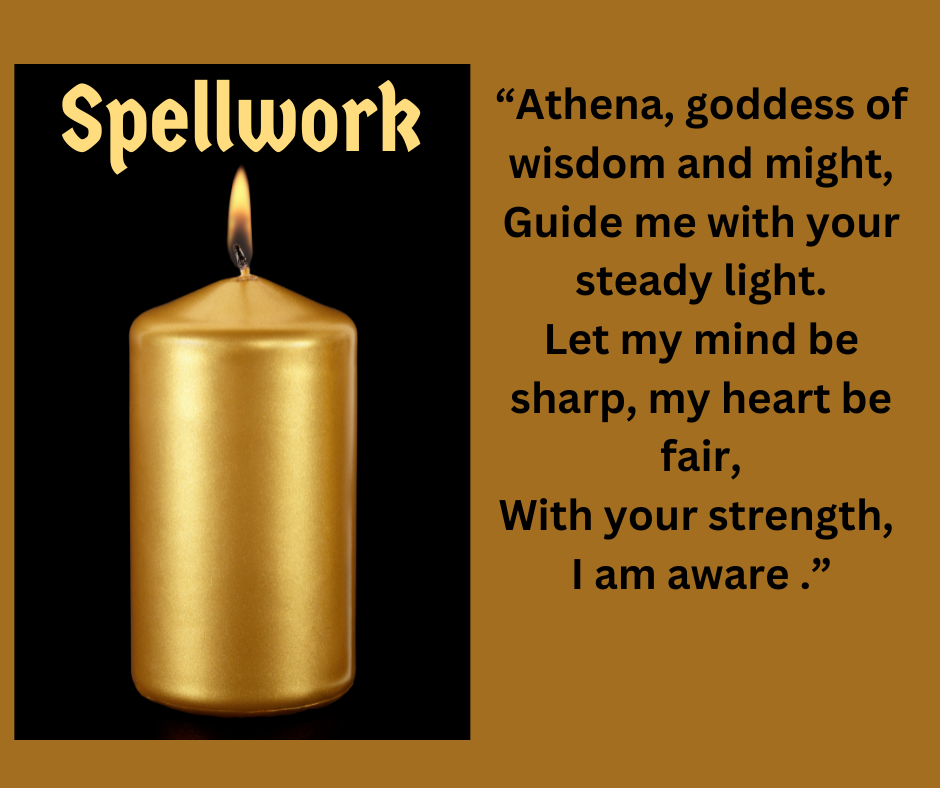
Invoke Athena
Invoke Athena in Spellwork
When you need clarity, strength in battle (emotional or intellectual), or protection, Athena is a powerful guide. Light a gold candle and ask her for guidance. You might say:
“Athena, goddess of wisdom and might,
Guide me with your steady light.
Let my mind be sharp, my heart be fair,
With your strength, I am aware.”
Create a small altar space dedicated to Athena with the things she loves. She appreciates beauty, simplicity, and meaningful intent.
Athena represents something we all need: the wisdom to navigate life's challenges with both intelligence and courage. If you feel called to work with her, trust that she will meet you where you are, ready to help you rise into your full potential.
Let her owl guide your vision, her olive tree ground your roots, and her wisdom sharpen your mind. The goddess of wisdom is still here—watching, guiding, and waiting for those ready to learn.

Loki Deity Guide: How To Work With This Norse God. Great for grimoire. Practical rituals.
This in-depth Loki deity guide gives you everything you need to start or deepen a devotional relationship with the Norse trickster god, sourced directly from the Poetic Edda and Prose Edda rather than pop culture retellings. 38 Pages.
Inside, you'll find Loki's family and mythology explained clearly, a dedicated section on his gender fluidity as it appears in the original Old Norse texts, his symbols and correspondences (with historical fact and modern pagan practice clearly labeled), and a full altar and offerings guide so you know exactly where to start. Whether you're new to Norse paganism, heathenry, or Asatru, or you've worked with Loki for years and want a well-sourced reference to return to, this guide is built to be genuinely useful, not just decorative.
Beyond the core guide, you'll get thirteen activities for honoring Loki, reflective journal prompts, two original devotional prayers, and a full step-by-step invocation ritual with practical tips for approaching this deity with honesty and respect.
This guide is perfect for anyone wishing to develop a respectful relationship with Loki and those seeking personal transformation through spiritual practice.
Introduction
Family
Children
Pride
Shapeshifting
Oath With Odin
Loki’s Binding
Nålebinding
Correspondences
Altar/Offerings
Prayers & Invocation
13 Activities To Honor Loki
Journal Prompts
Fire Ritual
Spells
Bibliography
Also available in my Etsy Shop
All of the writing is done by Ame (a human) with help from Erik (another human). Materials were made by me in the graphic design program Canva. Images are a combination of my photos, Canva elements, paid artists, and AI images created by me. Please message me if you have any questions!
© 2026 Celebrate Pagan Holidays LLC
All rights reserved. No part of this book may be used in any manner without the expressed permission of the author. You may not reproduce, duplicate, or transmit the contents. This listing is for personal use only.
8.5 x 11 inches (21.59 x 27.94 cm) PDF file.
For best printing use high-quality paper. Colors may differ due to monitor/printer variations. Final quality depends on your printer and paper.
This is a digital download, no physical item will be shipped. Instant download items don’t accept returns, exchanges, or cancellations. However, please contact us if you have any issues.