
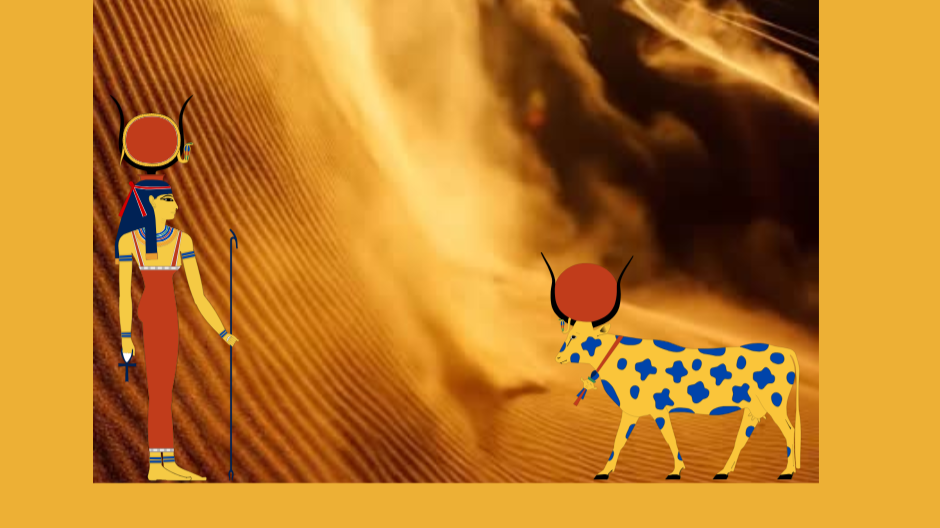
Hathor, a major goddess in the Egyptian pantheon, a sky deity, cosmic mother goddess represented as a cow, she remains one of the most widely worshipped deities.
We are taking a deep dive into Hathor, her rituals, honoring her and how to tell when she's reaching out to you.
Who Is Hathor?
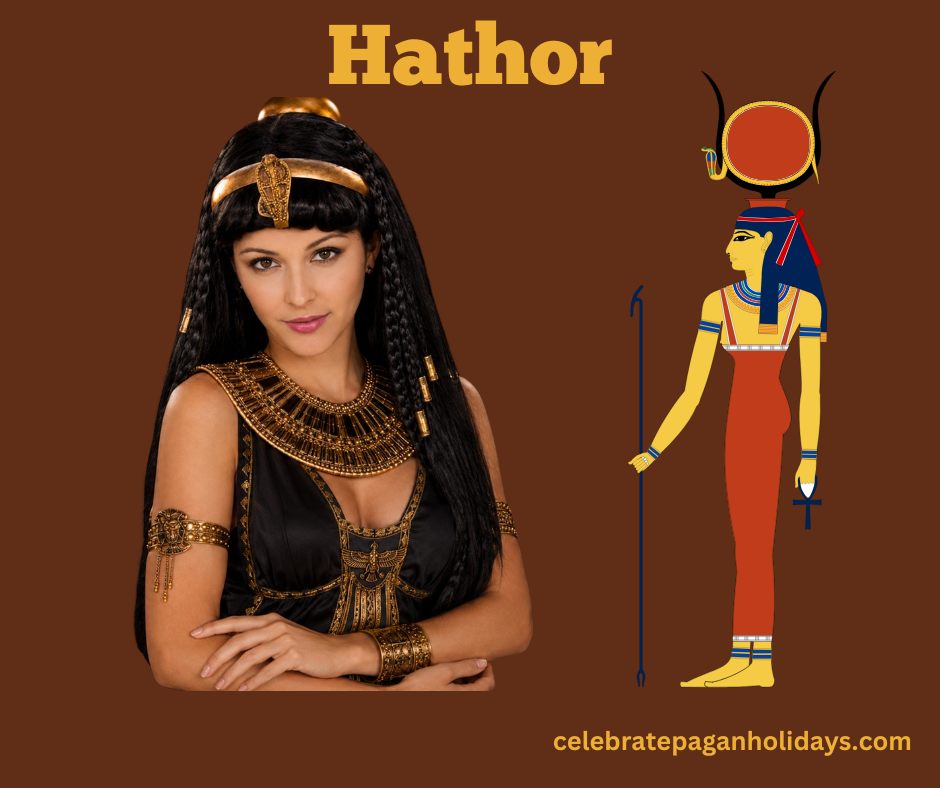
She represents beauty, music, dance, joy, love, motherhood, sexuality. Her festivals were lively with music and dancing. She is depicted as a woman with cow ears and cow horns holding a solar disk, or completely in the form of a cow.
Considered the “Mother of Mothers” she is a goddess of women, fertility, children and childbirth. She watches over women from problems with conception or childbirth, to health and beauty, to matters of the heart. Calling on her for love spells is popular.
Her name means house of Horus and she is described as either the mother or wife of the sky god Horus and the sun god Ra, The three of them represent kingship. As the daughter and feminine counterpart of the sun god Ra, she could act as the fierce "Eye of Ra," taking on a destructive or protective form (such as Sekhmet) to ward off enemies.
She has a long history. Her veneration began early in Egypt’s history, possibly in the Predynastic Era.
Hathor Correspondences
Symbols: Bull horns with sun disc, Menat necklace, Sistrum, Cosmetics, Mirrors
Culture: Egyptian
Abode or Planet: Sun and Pluto
Color: blue, green, red, and gold (What Do Candle Colors Represent)
Divination: Dream interpretation, Prophesy
Elements: Air
Animals: Cow, Cobra, Lioness,
Flowers: Lotus, Papyrus
Herbs: Myrrh, Rose
Stones: Carnelian, Copper, Gold, Hematite, Turquoise
Wood: Sycamore
Consort: Ra, Horus
“Giving praise to Hathor, who lives in Thebes
Kiss the earth for reverence to her in all forms…
It was on the day that I saw her beauty
My mind was spending the day in celebration thereof –
That I beheld the Lady of the Two Lands in a dream and she placed joy in my heart.”
Check out my Etsy Shop!
Epithets
Lady of Dendera
Lady of the Sky
Lady of Dance
Lady of Drunkenness
Lady of the West
The Distant Goddess
Hathor of the Sycamore
Lady of the Southern Sycamore
Mistress of the Desert
Mistress of Heaven
Mistress of Turquoise
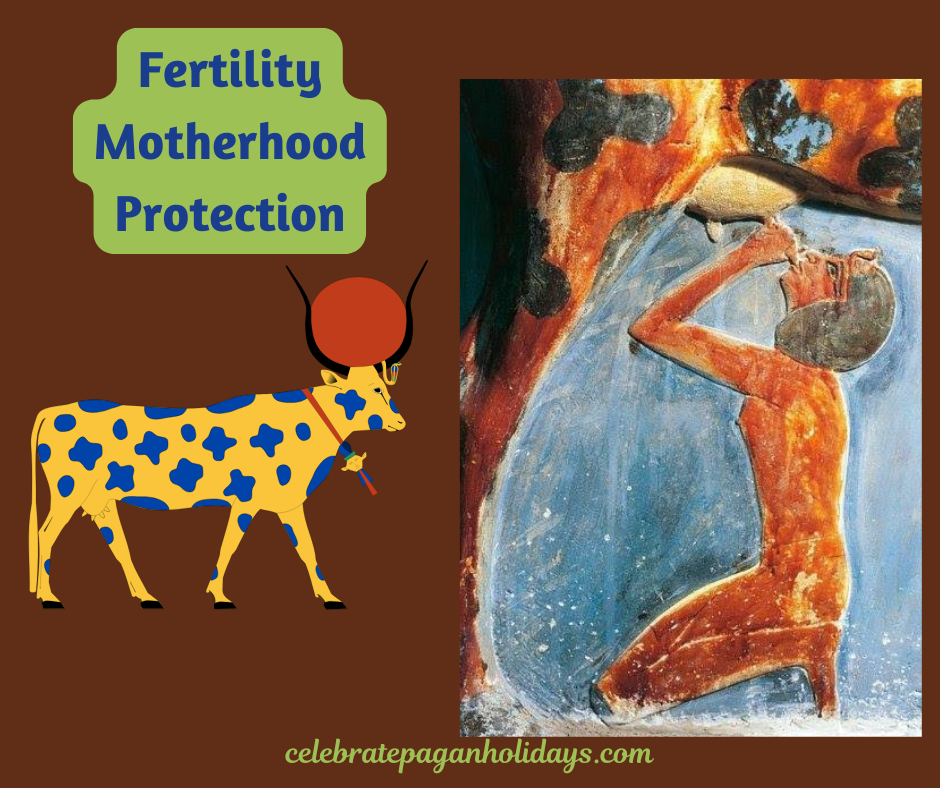
A common motif was Hathor as a cow. This Ancient Egyptian painting shows Hathor suckling Pharaoh Amenhotep II as a young boy. New Kingdom, 18th Dynasty (reign of Thutmose III, circa 1479–1425 B.C.)
Animals
Hathor was often depicted as a cow, symbolizing her maternal and celestial aspect, she wears a headdress of cow horns and a sun disk. The cow, symbolizes her life-giving energy and bounty toward humanity.
The same cattle that were domesticated in Africa are alive and well today. Ankole-Watusi cattle are medium-sized animals, with long, large-diameter horns, that attract attention wherever they appear. These regal animals can easily trace their ancestry back more than 6,000 years and have often been referred to as "cattle of kings."
Hathor could also be represented as a lioness, a cobra, or a sycamore tree. The lioness representing her more protective side and the cobra representing kinship and power.
Read my article: Snake as a Spirit Guide: Shed Old Energy And Transform
Plants And Herbs
Sycamore Tree
One of her epithets “Lady of the Sycamore”. The sycamore tree symbolizes strength, endurance, spiritual connection, protection, and rebirth. It is viewed as a gateway connecting the living with the afterlife and is often associated it with goddesses like Hathor, Isis, and Nut. She was sometimes depicted as handing out water to the deceased from a sycamore tree.
Papyrus
Papyrus is associated with Hathor through sacred rituals like the "shaking of the papyrus," where the rustling marsh stalks mirrored the sound of her sacred instruments, such as the sistrum.
Papyrus plants connect her with fertility, life, and the marshlands. In some temple scenes, papyrus is shaken in rituals performed in her honor.
Blue Lotus
The blue lotus symbolizes Hathor's nurturing energy, joy, love, and rebirth. She was frequently depicted in ancient Egyptian art holding or adorned with blue lotuses, and the flower was used in offerings and sacred perfumes for her cult. I have a video on them which includes how to grow them.
Wise Women or The Ta rekhet
Wise Women or The Ta rekhet meaning “the woman who knows” are seers and have a deep knowledge of the realms between the living, the gods, and the deceased. Their association with Hathor is implied by her role as an afterlife goddess who assists departed souls in their journey to the Field of Reeds.
5 Gifts of Hathor
These wise woman are connected to rituals like the "Five Gifts of Hathor," where a wise woman or priestess would raise a person's left hand to count five personal blessings or daily reminders of gratitude. The person would have to name the first five things which came to mind without thinking too precisely on them. Then she would tell them "Every day you have at least these five things to be grateful for and, should you lose one, there will always come another."
In ancient Egypt, where many were farmers, that person went back out into the fields and and when they reached out for a stalk of wheat to cut, they would see their left hand before them and be reminded of the five gifts of Hathor. I find this a great practice today.
I spent most of my teaching career in public school but I did teach Science in Catholic school a couple of years (go figure) and they did something interesting. In their religion class they would trace/outline their hands on a piece of paper. Then they would write 5 things they were grateful for next to each finger.
As soon as we stop feeling grateful, we move toward darkness, disbelief, and bitterness in life. The Five Gifts of Hathor, which we can connect with by simply looking at the fingers of our left hand, are constant reminders of all that is good and important and worth waking up for every morning - and giving thanks for every night.
Its important to maintain personal balance, especially in difficult times.
By keeping one's mind and heart centered on Hathor, her inner and outer beauty, we receive joy. Hathor teaches that gratitude helps neutralize the power of negative thoughts and feelings such as jealousy, envy, and bitterness.
Ancient Egyptian religious philosophy believes that chaos and order, or wrath and mercy, can not exist without each other. Sekhmet is the dangerous, necessary force that destroys threats or corruption, while Hathor is the peace, healing, and renewal that follows.
Goddesses highlight the multifaceted roles of women in ancient Egyptian society, from protectors and warriors to nurturers and caregivers.
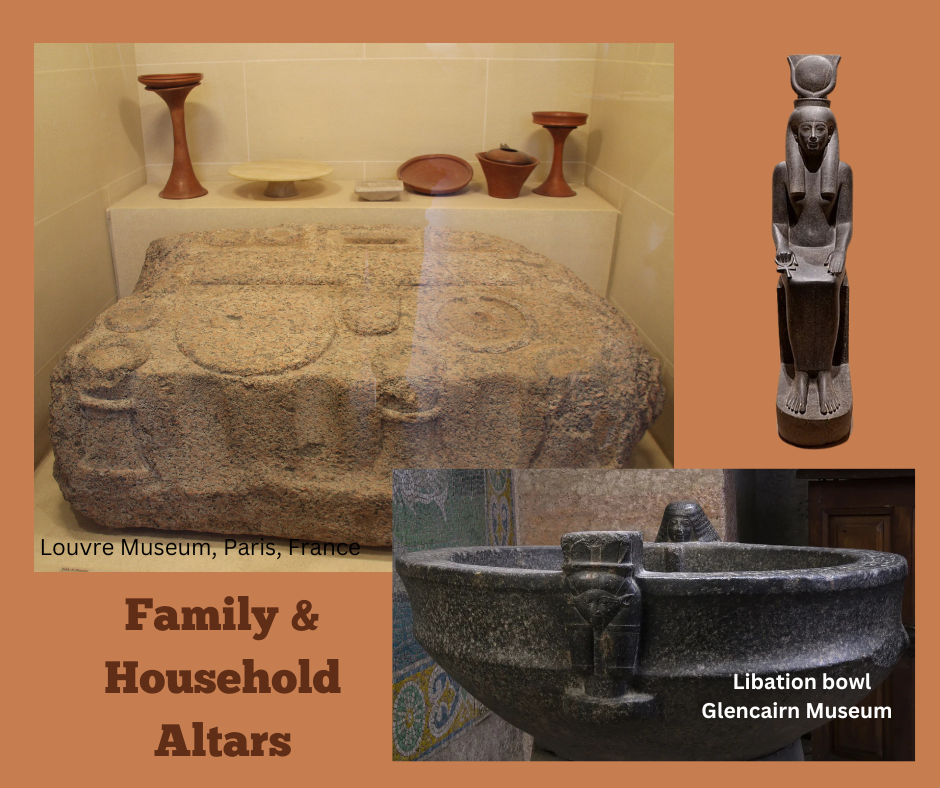
It was quite common for Ancient Egyptians, including working class families, to have a household altar. Archaeological evidence has found numerous altars along with small statues and amulets in homes.
Household altars
In Egypt, she was one of the deities commonly invoked in private prayers and votive offerings, particularly by women.
Family household altars were common in ancient Egypt. They were often simple, flat spaces where food, drink, incense, or flowers could be left as offerings to the gods or ancestors. Stone offering tables were carved with channels for libations and images of bread and meat, ensuring the spirits would always be nourished. In private homes, small shrines and altars connected families to protective deities. In previous videos we talked about the many small stone statues of Bes or Taweret that are found at archaeological sites.
A Libation bowl would have been a common household object. This one is adorned with Hathor and her presence is thought to absorb and activate the magical power and connections of the offerings. Hathor loves offerings of beer or pomegranate juice, dates, milk or barley bread.
Check out my article Pagan Altars: Beginners Guide
Offerings
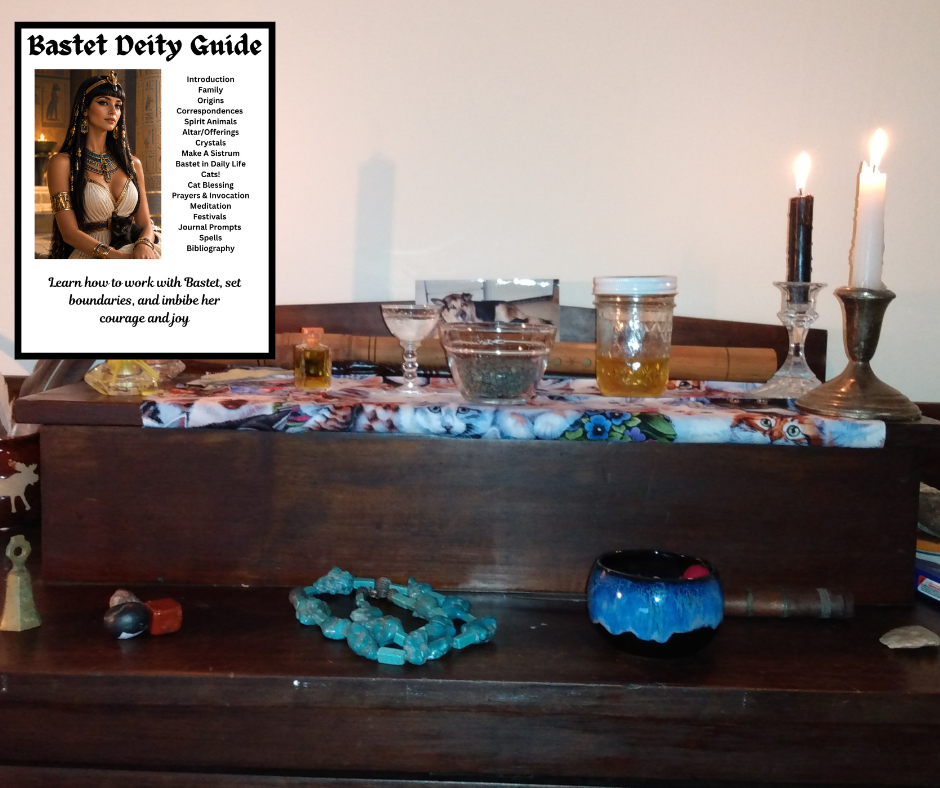
This is my Bastet altar with offerings. Check out my in-depth Bastet deity guide, 44 pages, gives you everything you need to start or deepen a devotional relationship with the Egyptian goddess of protection, home, fertility, and cats!
Bastet is one of my patron deities and this is my altar to her. I have a detailed explanation of it in my Bastet video. You could do something similar for Hathor with items that symbolize her. I very much enjoy altar work and having a space that is conducive to building relationship with deities and working on my own spiritual growth.
Also in my Etsy shop I have a deity guide for Bastet. And Im about done with my one for Anubis. I do hand write them so it takes some time.
Prayer To Hathor
This prayer to Hathor, from the Stela of Ipui (18th Dynasty, c. 1500 BCE), a funerary monument, that emphasizes this aspect of the goddess. The prayer reads, in part:
Giving praise to Hathor, who lives in Thebes
Kiss the earth for reverence to her in all forms…
It was on the day that I saw her beauty
My mind was spending the day in celebration thereof –
That I beheld the Lady of the Two Lands in a dream and she placed joy in my heart.
Then I was revitalized with her food…
He who is wise
Will honor her at the seasonal festival
That which gives teaching to the people
Might be regarded to be pure food.
Near the servant in the Place of Truth, Ipui, the Justified, says:
In order to solve the problem of rivalry, jealousy, and coveting her,
The wonders of Hathor, which she did in ancient times,
Should be related to the ones who do not know and the ones who do know.
A generation should tell a next generation how beautiful she truly is. (Thompson, 4)
Ways To honor Hathor
Read the Book of the Heavenly Cow
Daily prayers
Show and share gratitude
Donate either money, clothes, or time to those less fortunate
Dance
Play music
Create a song for her (or a playlist!)
In her role as goddess of beauty, she was the patron of cosmetics. Wearing cosmetics was seen as a form of worship to Hathor, and offerings of mirrors or cosmetic palettes to her were common. The Egyptians used eye makeup made from ground malachite which had a protective function (in fighting eye infections) which was attributed to Hathor.
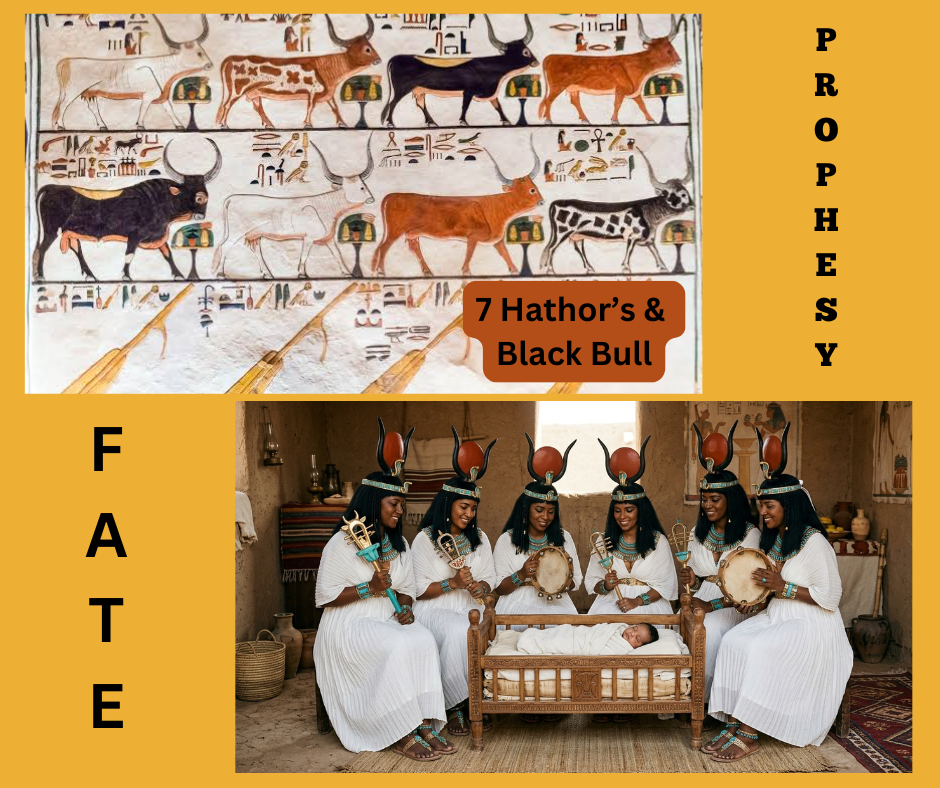
The Seven Hathor’s
Another one of her responsibilities was to be present at a person's birth – in the form of the Seven Hathor's – and decree the newborn's fate.
Shortly after a child was born, the Seven Hathor's appeared to foretell the infant's destiny, predicting major life milestones, hardships, and the manner or timing of their death. The Seven Hathor's are frequently shown in art, such as in the tomb of Nefertari or the Book of the Dead, either as seven cows or as women representing Hathor.
The number seven has been a power number throughout history. Repeating an utterance or action seven times gives it extra potency, and thus a sevenfold of goddesses will be extra powerful. The goddess Hathor is associated with love, sexuality, and motherhood.
In her Temple of Dendera the Hymn of the Seven Hathor's venerates Hathor and highlights her supreme authority.
Hathor Mother To Pharaoh
Hathor is often shown in her bovine form suckling the king or as a woman offering nourishment. Hathor was considered the divine mother, protector, and wet-nurse of the pharaoh, viewing the ruler as her symbolic son.
In the Temple of Dendera (circa 1500 BC), is found the Hymn of the Seven Hathor’s.
Hymn of the Seven Hathors
We play the tambourine for your ka,
We dance for your majesty
We exalt you – to the height of heaven.
You are the Mistress of Sekhem, the menat and the sistrum
The Mistress of Music for whose ka one lays
We praise your majesty every day
From dusk until the Earth grows light,
We rejoice in your countenance, O Mistress of Dendera.
We praise you with song.
You are the lady of Jubilation, the Mistress of the Iba dance,
The Lady of Music, the Mistress of Harp playing,
The Lady of Dancing, the Mistress of Tying on Garlands,
The Lady of Myrrh and the Mistress of Leaping.
We glorify your majesty – we give praise before your face.
We exalt your power over the Gods and Goddesses.
You are the Lady of Hymns,
The Mistress of the Library – the Great Seshat.
At the head of the Mansion of Records,
We propitiate your majesty every day.
Your heart rejoices at hearing our songs.
We rejoice when we see you, day by day.
Our hearts are jubilant when we see your majesty,
You are the Lady of Garlands, the Mistress of Dance
The Lady of Unending Drunkenness.
We rejoice before your face, we play for your ka.
Your heart rejoices over our performance.
'The Hymn of the Seven Hathors'. In south crypt 2 of the temple at Dendera.
Translated by: S. Cauville, "Dendara V-VI: Traduction" (2004) ; English version by Sandra Ottens
Divination
Traditional practices attested in ancient Egypt.
• Dream Interpretation and Incubation. Hathor's temples served as centers where worshippers slept to receive healing or prophetic visions. Her priests acted as trained oracles who interpreted these dreams for visitors seeking divine guidance.
• Prophecies of Birth and Fate. In her manifestation as the Seven Hathor’s, she functions as a prophetess who appeared at the birth of a child. These seven aspects announce a person's destiny and predicted the length or manner of their life.
• Temple Processional Oracles. Like other major state deities in ancient Egypt, Hathor’s sacred cult statue was carried by priests during public festivals. Petitioners would ask questions aloud, and the movements of the sacred barque (such as tilting forward or backward) were read by priests as "yes" or "no" answers from the goddess.
Modern Divination Practices
• Catoptromancy and Hydromancy (Scrying). Bronze hand mirrors were sacred attributes of Hathor symbolizing the sun disk. Modern practitioners often dedicate mirror scrying to her. Gazing into bowls of water lit by the full moon is used as a form of "Hathor's Mirror" scrying to receive intuitive visions.
• Astrology and Star Lore. Known as the "Lady of Stars" and linked to the sky, the constellation Ursa Major, and the star Sirius (Sothis), Hathor is frequently invoked in celestial divination and Egyptian astrological traditions. The famous Dendera Zodiac, an ancient bas-relief map of the heavens, was originally housed in a chapel dedicated to Osiris within Hathor's temple complex.
• Cartomancy (Tarot and Oracle Cards). In contemporary spirituality, Hathor is a common patron for readings focused on love, relationships, fertility, and emotional healing. Many practitioners use dedicated Hathor oracle decks or associate her with the Empress card in traditional Tarot due to her domains of abundance, motherhood, and beauty
This is one of my favorite tarot decks. I use it frequently! African Goddess Rising Oracle
Mistress of The sky
Hathor was given the epithets "mistress of the sky" and "mistress of the stars" . She is also associated with the afterlife, consoling and guiding the souls of the dead, and was further linked with the Milky Way which was seen as a heavenly Nile River, sustainer of all life. Go outside at night when the milky way is visible and leave her an offering.
In ancient Egypt, the Star Cluster we call the Pleiades was know as "The Celestial Herd" and were an import part of the system of timekeeping and a seasonal marker.
The seven cows represented by the seven brightest stars represent the milk of life.
1. Lady of the Universe
2. Sky-storm
3. You from the land of silence / The hidden one, presiding over her place
4. You from Khemmis
5. Red-hair
6. Bright red
7. Your name flourishes through skill / Your Name prevails over the West
Hathor, a major goddess in the Egyptian pantheon, a sky deity, cosmic mother goddess represented as a cow, she remains one of the most widely worshipped deities. This video takes a deep dive into Hathor, her rituals, honoring her and how to tell when she's reaching out to you.
Hathor’s Temples
Hathor's worship was widespread throughout Egypt and especially popular among the poor. More temples were dedicated to her than to any other goddess. Her most prominent temple was Dendera in Upper Egypt. And in Thebes. She was also worshipped in the temples of her male consorts Ra and Horus.
The Temple in Dendera is one of the best-preserved temple complexes in ancient Egypt. There are shrines to many deities and even a Sanatorium
that functioned similarly to a Roman bathhouse, but strictly for bathing and overnight stays to manifest healing dreams. The waters at Dendera were sacred and were often used to bless the inscriptions on statues so that they could cure diseases.
The Dendera Temple is open to visitors and The Egyptian Ministry of Tourism and Antiquities has a website with information.
She had both female priestesses and male priests in her temples. Dancing and playing music are popular ways to honor her and part of religious life. The sensory pleasures of life, are the gods' gifts to humanity. Ancient Egyptians ate, drank, danced, and played music at their religious festivals.
Sistrum
The sistrum was a sacred instrument in ancient Egypt. The sounds made by the percussive instrument along with the rhythm of the music was largely important for calling upon deities, the repetitive sound thought to aid in ritual healing and alter reality. In hymns and temple reliefs, musicians play tambourines, harps, lyres, and the sistra in Hathor's honor. The sistrum, a rattle-like instrument, was particularly important in Hathor's worship. It had erotic connotations and, by extension, alluded to the creation of new life.
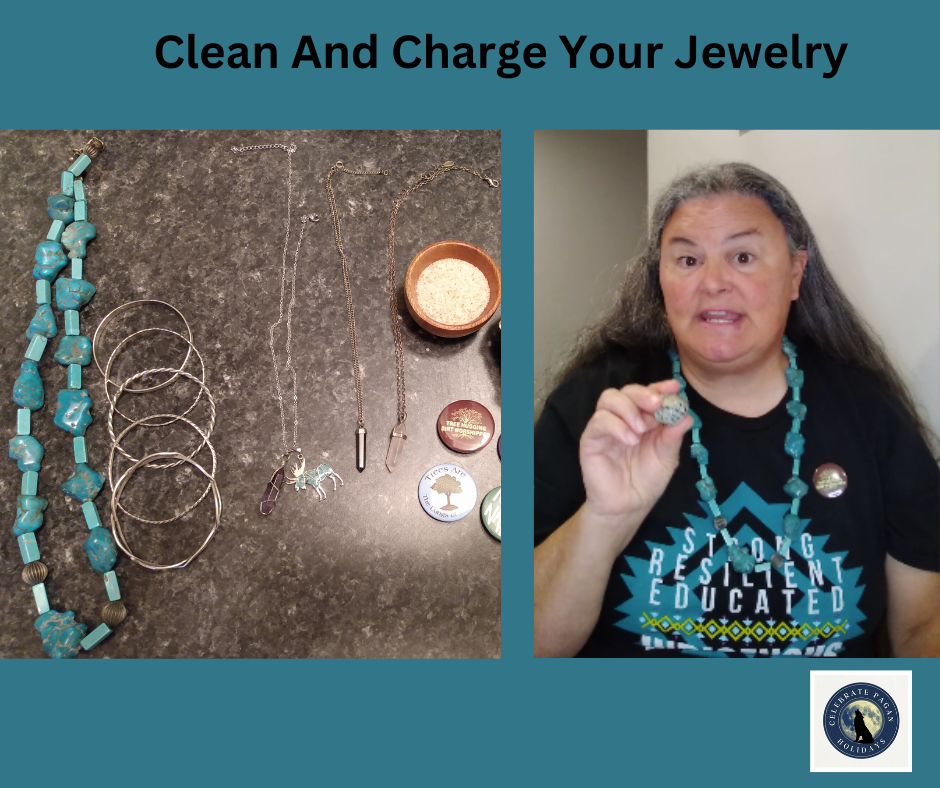
I have a video on taking care of your pagan jewelry. Just click on the image to view it.
Hathor’s Crystals
The menat necklace is a heavy beaded necklace used in religious ceremonies and closely linked with Hathor. It can be worn or shaken during ritual and is connected with protection, fertility, rebirth, and divine blessing. The “sound” emitted was magical and could “appease a god or a goddess”.
I love my turquoise necklace and find it has a lot protection energy. My jewelry leans more into my Native American history but I have found my turquoise necklace works well with my worship of Bastet as well. Hathor has an epithet 'Mistress of Turquoise'.
She served as the divine protector and patron deity of turquoise and copper miners who worked the harsh desert expeditions in the Sinai Peninsula.
To the ancient Egyptians, turquoise represented her radiant and life-giving energy
A favorite Egyptian color scheme was red, light blue-green, and dark blue. These hues generally were represented by carnelian, turquoise, and lapis lazuli. Lapis Lazuli represent the heavens, royal wisdom, truth, and spiritual insight. Carnelian is associated with the life-force, courage, vitality, and the heat of the sun.
Together, these three stones formed a balanced amulet of protection.
Festivals
Hathor has many festivals throughout the year. More festivals were dedicated to her and more children were named after her than any other god or goddess of Ancient Egypt. Her worship was not confined to Egypt and Nubia. She was worshipped throughout the countries of what are today Ethiopia, Somalia, and Libya, and was particularly venerated in the city of Byblos.
Festival of the Beautiful Reunion
I have her under fall here on the website but the Festival of the Beautiful Reunion is in the spring.
During this festival the statue of Hathor traveled down the river from her main temple in Dendera to the Temple of Horus in Edfu. Communities gathered along the Nile with musical instruments playing and singing. They shared wine to celebrate the sacred union of Hathor and Horus.
The reunion renewed fertility, cosmic balance, and abundance across the land.
Festival of Drunkenness
Festival of Drunkenness is held in summer. It celebrates the myth where red-dyed beer pacified the wrathful goddess Sekhmet, saving humanity from destruction.
This festival was held annually on the 20th day of the first month of Akhet (the season of inundation)
You can always honor hathor through dance. Express your joy. Offer her your energy and happiness.
Hathor plays a vital role as a member of the divine entourage and protector that accompanies the sun god Ra as he sails across the sky in his solar barque. As a solar deity and feminine counterpart to Ra, she is often called the "Golden One", reflecting the brilliant radiance of the sun, with temple texts from Dendera noting that “her rays illuminate the whole earth”
Normally, Hathor is known as a deity of love, beauty, music, joy, fertility, and maternal care. However, as an extension of Ra, the Eye acts independently to defend the sun god from his enemies and punish rebellion.
Check out my video on the eye.
Afterlife
Hathor was said to be be the mother or wife of Horus depending in the source. The coffin texts state that the house of Horus was in the sky. This puts her in the cosmic realm and closely connected with the sun.
Hathor was also called Mistress of the west because of her vital role in ancient Egyptian funerary beliefs. In tomb paintings and funerary texts, she is often depicted offering food, drink, and spiritual nourishment to deceased spirits to sustain them on their journey.
Is Hathor Calling To You?
Is Hathor trying to get your attention. A friend told me during a rough time in her life that she kept hearing the sound of a cow mooing. It took her a while but when she turned to Hathor the mooing stopped and she started to feel some guidance and was able to work towards resolving her issues.
There may be a petting farm or you may live in the countryside and be able to connect with a cow. Another idea is to support a farm animal sanctuary.
You may be walking in a botanical garden and be interested in the lotus growing in the ponds. The smell of flowers or incense may trigger a connection. Hathor loves beautiful flowers and their smells.
Meditating is always a good way to connect because you close down the distractions around you and are more likely to be open and receptive.
Sensations of Comfort and Nurturing. If you feel comforted, nurtured, or protected, especially during challenging times, you may be experiencing Hathor wrapping you in her maternal embrace.
Take a bath with flowers and milk to nurture your body and open up lines of communication. Hathor wants us to be happy which relates to positive self care.
Author, Ame, is the founder of CPH, an eclectic pagan, green with and environmental educator. Learn more about us here.


Have you ever wondered how ancient Egyptian goddesses can inspire us today? Bastet, the Egyptian cat goddess is more than just a figure from mythology - her energy is alive and relevant today. Even though thousands of years separate us from ancient Egyptian culture, Bastet’s values remain relevant. By embracing her principles, we can reshape and enrich our lives, learn to find balance, and give back to our communities.