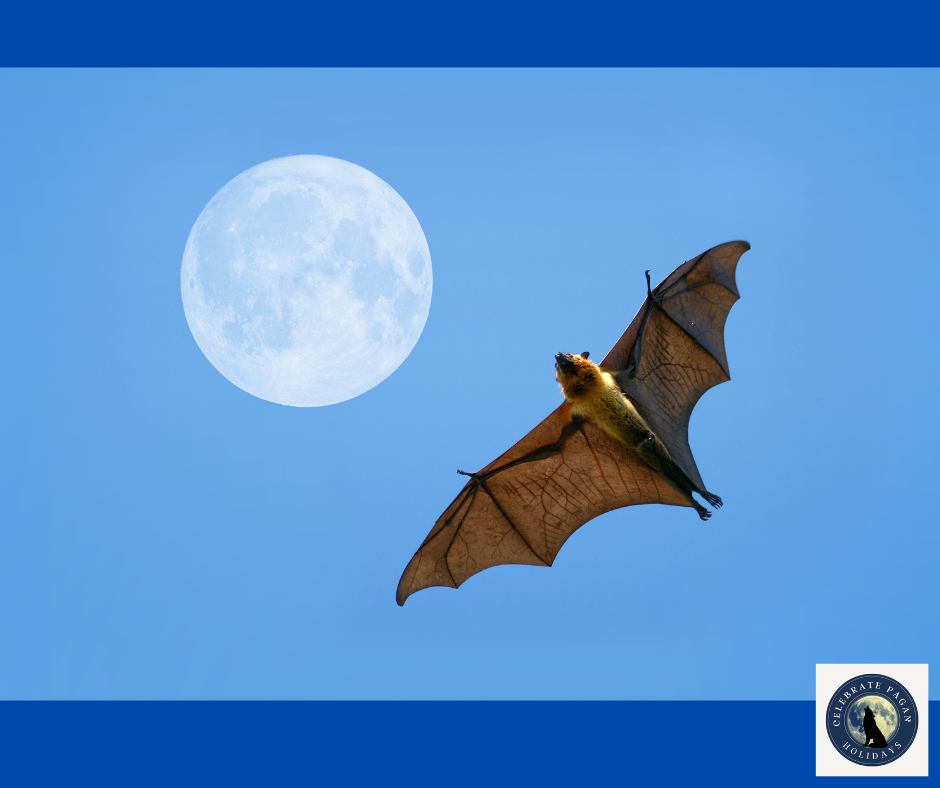
Bats are one of those animals that people either love or instinctively flinch from. For pagans and witches, we tend to land firmly in the "love" category - and for good reason. Bats have a rich spiritual symbolism among pagan cultures worldwide. If a bat has been showing up in your life — physically, in dreams, or as a recurring symbol - it's worth understanding what this animal has to say.
Bat Symbolism
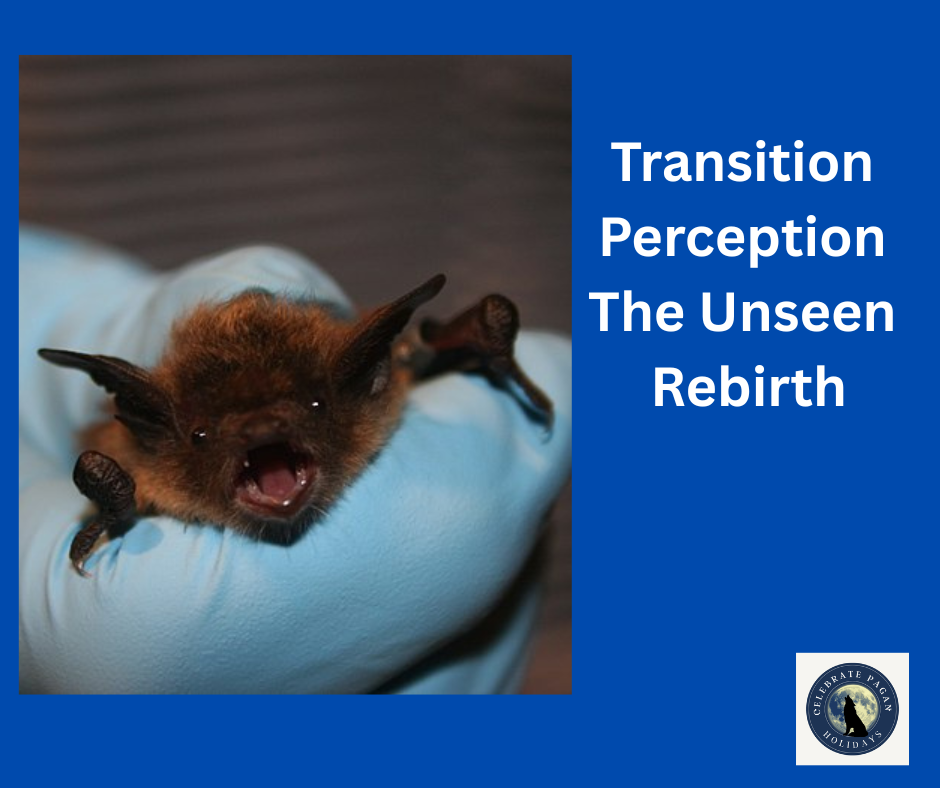
Bat symbolism centers on a few core themes that appear consistently across cultures: transition, perception, the unseen, and rebirth.
Bats are liminal creatures. They occupy that transition period between day and night, emerging at dusk to hunt for food. They are the only flying mammal, using senses beyond ordinary sight. In many traditions, bats symbolize the ability to move between worlds, to find your way in darkness, and to perceive what others cannot.
Because bats roost in caves, gateways to the underworld, they are connected to death and rebirth. Not death in a grim sense, but in a transformational sense: the ending of one phase and the beginning of another. Bats sleep hanging upside down, which many interpret symbolically as seeing the world from a different perspective, or willingness to let go of what no longer serves you.
Other common symbolic associations include:
Intuition and inner knowing — bats navigate by echolocation, trusting senses beyond sight
Community and social bonds — most bats are highly social and roost in large colonies
Adaptability — bats thrive in diverse environments across the globe
Fertility and abundance — in some traditions, particularly in Asia, bats are powerfully lucky symbols tied to prosperity
What Bats Teach Us
When bat comes to you as a spirit guide, it tends to appear at moments of significant transition or when you need to trust your instincts over surface appearances.
Trust your inner senses. Bats don't rely on sight to navigate. They emit sound and listen to what comes back. As a spirit animal, bat encourages you to develop and trust your intuitive senses — the information you receive that doesn't come through ordinary channels. If something feels off, bat says: pay attention to that.
Face the dark. Bat doesn't avoid darkness; he thrives in it. A bat spirit guide asks you to stop treating shadow, your own or the world's, as something to escape. Shadow work, facing grief, sitting with uncertainty, bat supports you.
Let go and transform. That upside-down roost posture isn't just interesting biology. Symbolically, it represents surrender and willingness to release old patterns. Bat as a guide often signals that it's time for a real change.
Community matters. Some bat species roost in colonies of millions. Bat can be a reminder that your spiritual community, your chosen family, your coven or grove — these connections matter and deserve attention.

I’m adding new products every week.
Why Are Bats Connected to Witches?
The association between bats and witches transcends the ages. It is old and runs through multiple cultures, though it became was amplified in Western Europe during periods of witch persecution.
Many feared that bats were considered familiars and assisted witches in their magical work. Because bats have been poorly understood for most of human history, they were easy targets for fear-based folklore. Flying creatures that moved at night and disappeared into caves carried obvious associations with witchcraft in the popular imagination.
Practically speaking, bats frequented the same spaces that pagans and witches often used: forests, old buildings, ruins, and other liminal places where people might gather away from community oversight. This proximity likely reinforced the association.
There's also a connection through herbalism. Belladonna (deadly nightshade), a plant deeply associated with witchcraft, attracts bats because of its night-blooming flowers. Some researchers have noted that historic "flying ointments" used by European cunning folk and witches may have contained bat ingredients — whether symbolically or literally.
In Shakespeare's Macbeth, the three witches include "wool of bat" in their cauldron. This reflects the period's popular conflation of bats with dark magic, though the actual historical folk practices were far more nuanced and regionally varied.
For modern witches and pagans, the bat connection feels right because of what the animal genuinely represents: working in shadow, trusting unseen forces, navigating between worlds. Bat is a natural companion for that kind of practice.
Bats in Pagan Cultures Around the World
Mesoamerica: Camazotz
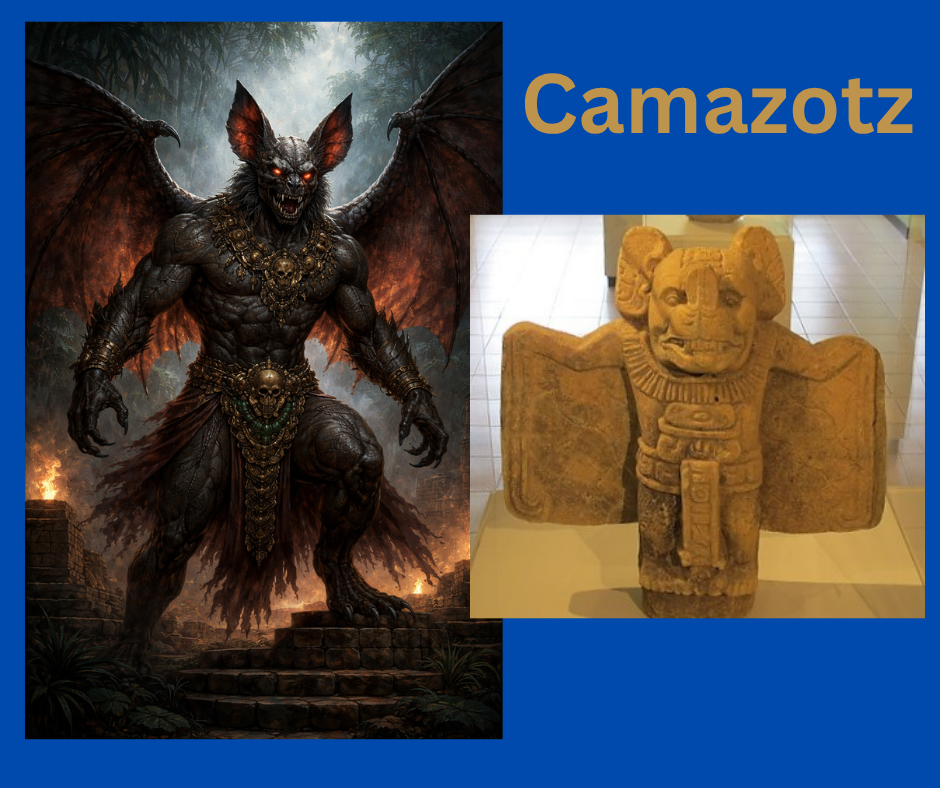
The most prominent bat deity in pagan tradition comes from Mesoamerican religion. Camazotz, whose name translates roughly to "death bat" in the K’iche language which is still widely spoken in Guatemala and parts of Mexico today.
Camazotz was a Mayan bat god associated with death, sacrifice, night, and the underworld (Xibalba). He appears in the Popol Vuh, the K'iche' Maya creation epic, as one of the lords of the underworld.
Camazotz is a complex figure. He kills Hunahpu, one of the Hero Twins, by decapitating him. But he is also part of the cosmic order. The Zapotec people had their own bat deity, and bat iconography was widespread throughout Mesoamerican art and religion. He looked terrifying but the bat was a highly respected animal. He was not evil but rather a powerful force tied to transformation, sacrifice, and the cycles of life and death.
China: The Five Bats (Wu Fu)
In Chinese traditional culture, the bat (蝠, fú) is one of the most auspicious symbols you can have. The word for bat is a homophone for "luck" or "fortune," making it a favorite motif in art, architecture, and textiles.
The "Five Bats" or Wu Fu (五福) represents the Five Blessings: longevity, wealth, health, virtue, and a peaceful death. Red bats are especially lucky. This is a culture where having a bat fly into your home was considered an excellent omen - the direct opposite of European superstition.
Longevity (壽, Shòu): A long life not prematurely ended by excess or self-destruction.
Wealth (富, Fù): Material stability that allows one to support themselves and others without anxiety.
Health and Composure (康寧, Kāngníng): A body that functions well and a mind free from unnecessary conflict.
Love of Virtue (攸好德, Yōu hǎo dé): Natural alignment with moral goodness and acting in ways that do not disturb the balance.
A Peaceful End (考終命, Kǎo zhōng mìng): Passing away naturally of old age without pain, suffering, or chaos.
Ancient Egypt
The Egyptians saw an association between bats and the dead, but not in a fearful sense. Because bats lived in tombs and caves, they were seen as having proximity to the deceased and the underworld. Various species, including the Egyptian Fruit Bat (Rousettus aegyptiacus) and Egyptian Tomb Bat (Taphozous perforatus), inhabited caves, tombs, temples, and pyramids.
In Ancient Egypt, bats were generally viewed as symbols of good luck, protection against evil, and guardians of the night. Some Egyptian amulets and charms featured bat imagery, and bats appear in medical papyri as ingredients in remedies and protective magic.
Ancient Egyptians associated bats with the goddess Isis and viewed them as creatures that brought good luck. They felt bats symbolized the balance between light and darkness. They were believed to be personifications of the soul, sometimes depicted in tomb paintings flying toward the afterlife. They were sometimes believed to be the manifestation of a soul traveling to the afterlife.
Isis is connected to the underworld through her role in resurrecting her husband, Osiris, who became its ruler. She used powerful magic to reassemble his dismembered body and assisted him in entering the afterlife.
Read my article Queen of the Throne: Honoring Isis
Anubis is a well-liked and respected Egyptian God. He is both the weigher of the heart (judgment) and the protector of souls (guardian). Learn how to set up an altar, give service to him, and allow him to guide you through hard times.
As the god of death and embalming, Anubis presided over the weighing of hearts in the underworld to judge the dead. Death was just as important as life. Therefore, Anubis was a major part of the transition from life to death and back to life again. Anubis wants us to work hard. Don't be afraid of the dark in your hearts; accept it to do shadow work, even if it might be painful.
Ancient Greece and Rome
Like other cultures, Ancient Greeks associated bats with the underworld, death, and the supernatural. They appear in ancient literature in Homer’s writings representing souls of the dead. The connection runs deeper than symbolism — it is embedded in the oldest Greek texts. In Book 24 of Homer's Odyssey, the souls of the dead are described moving through the underworld like bats, gibbering and flitting through the dark as Hermes leads them to the realm below.
Animals that dwelled at that threshold, bats, especially, belonged in some sense to Hades and Persephone, the deities of that realm. Bats were among the sacred animals of Persephone in particular, fitting her nature as a goddess who moves between the living world and the dead. Her dual existence, part of each year above ground, part below, mirrors exactly what the bat represents: a creature that inhabits the in-between, comfortable in darkness, connected to what lies beneath.
If you work with Persephone or Hades, bat imagery and bat energy are important for your devotional relationship. Incorporate bats into altar work through imagery or symbolic offerings.
A prominent myth involves the daughters of King Minyas. His daughters Alcathoe, Arsippe, and Leucippe, disrespected Dionysus by neglecting his rites and insulting his worshipers. For a punishment Dionysus drove them mad, causing vines and ivy to grow over their weaving looms. When they still refused to honor him, he transformed them into bats to haunt dark places, away from the light of day. Bats are considered one of Dionysus's sacred animals due to this myth.
Read more about Dionysus (called Bacchus in Ancient Rome) Roman Festival Of Bacchus.
Indigenous Americas
In addition to the Maya, bat figures appear in the folklore and spiritual traditions of many Indigenous peoples across North and South America. Bats often hold a significant place in the spiritual practices of shamans - the ability to move between the living world and the spirit world. Many Native American cultures see them as a sign of dualism, change, or hidden identity.
Navajo regard the bat is a divine intermediary of the night. Called Jaa’abání, the Navajo word for bat. The bat offers aid to humans and carries offerings from the gods to earth. In addition to helping people at night, Jaa’abání is also the guardian of the eastern sky. Culturally, they are credited with keeping the earth balanced by pollinating plants and guarding crops against destructive insects.
Cherokee: Bats are sometimes viewed as trickster spirits, but their presence can also be interpreted as a sign that something positive is about to happen. In Cherokee tradition, the bat is central to a key origin legend regarding stickball (lacrosse), where it helped the birds win against the animals. During the game, two small mice wanted to join the birds team, but they had no wings. The birds made wings for them out of a drum and leather, creating the first bat and the first flying squirrel.
Today, the Eastern Band of Cherokee Indians and the Cherokee Nation actively monitor and protect endangered bat species, such as the Ozark big-eared bat, on tribal lands. Tribes are monitoring threats like white-nose syndrome, a fungus devastating bat populations across the United States.
Blackfoot: Traditionally held a less favorable view, sometimes believing bats were poisonous or dangerous. Linguistically, the Blackfoot word for bat is associated with tepee poles, possibly because bats roosted in their dwellings. Additionally, bats appear in Blackfoot mythology, specifically in stories involving the trickster figure Naapi.
AfricaN Traditions
Zulu: Bats are revered as intermediaries between the living and the spirit world, acting as protectors that guide ancestral insights. Zulu traditions consider bats as harbingers of good fortune and prosperity. They are viewed as symbols of mystery and transformation, with a strong belief that harming them brings bad luck.
Learn how to connect with bat's powerful spiritual guidance. #witches #paganism
Bats in Dreams
Dreaming of bats is generally interpreted as significant, and the meaning shifts based on what the bat is doing and how the dream feels.
A bat flying freely often signals transformation in progress. Something in your life is changing, or needs to change, and the bat is confirming that movement. This is generally a positive sign.
A bat in a cave or dark space can indicate that you need to go inward. Something important is waiting in your shadow such as an unexamined belief, an unprocessed emotion, or an insight that requires quiet attention to surface.
A bat flying toward you may signal that a message is incoming. Something from your intuition or from the spirit world that you need to be ready to receive.
A bat attacking or biting can indicate that you're avoiding something that needs your attention. The shadow has gotten pushy.
A dead bat in a dream typically signals the end of a cycle or transformation completed. This is not a bad omen, it's more like a marker that a significant phase is closing.
Many bats together often connects to community, ancestors, or the collective unconscious. A large colony of bats can signal ancestral communication or the importance of community in what you're currently navigating.
Working with Bat as a Spirit Animal
If bat has come to you as a guide, some practical ways to honor and deepen that connection:
Spend time near actual bats. At dusk, find a place where bats are active — near water, near old buildings, at forest edges. Simply observe. Bats are not dangerous, they're beneficial (a single bat can eat thousands of insects per night), and watching them navigate in near-darkness is genuinely striking.
Shadow work is bat's domain. Journaling, dream work, ancestral work, working with what you'd rather not look at. Bat supports all of it. If you've been avoiding something, bat as a guide is a fairly direct signal to stop.
Work at liminal times: dusk, dawn, the new moon. Bat energy is most available at threshold moments.
Use bat imagery in altar work when you're in periods of transition, when you're developing psychic skills, or when you're doing any kind of underworld work.
Bat is a guide for anyone willing to trust what they cannot see. That's as useful in a magical practice as it is in everyday life.
Author, Katherine Fox, is our editor and one of our writers. She is currently raising a pagan husband and three children. They love getting outside and exploring the natural world. Find out more about us here.