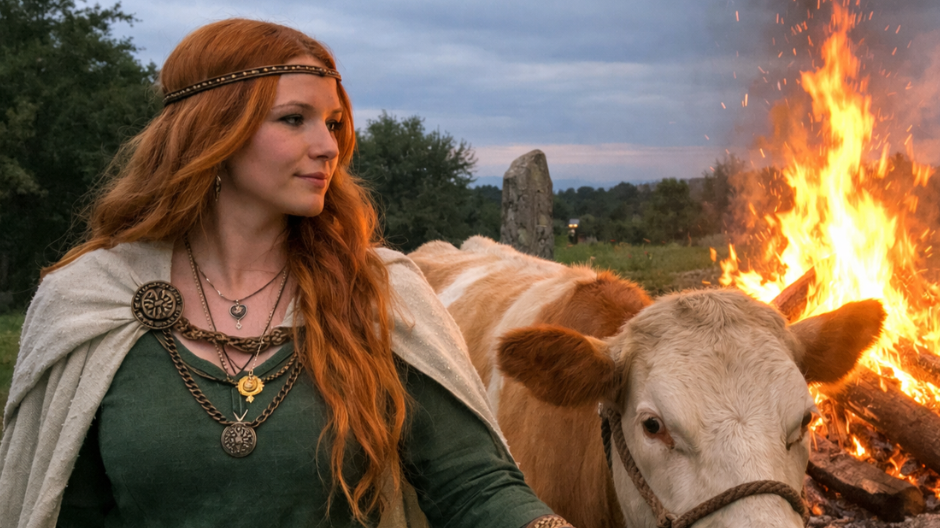
Imbolc, which welcomes in spring, is also referred to as Candlemas or Oimelc. The next celebration will be occurs on Monday, February 1, 2027. This is an exciting holiday of the returning light. Spring is coming!
The Celtic holiday honors Brigid, the fire goddess of healing, inspiration, and smithcraft. The mantra is refresh, renew, rededicate!
Imbolc is a cross-quarter holiday, midway between winter and spring. It’s one of the eight Wiccan Sabbats in the Wheel of the Year and one of the four Gaelic seasonal festivals.
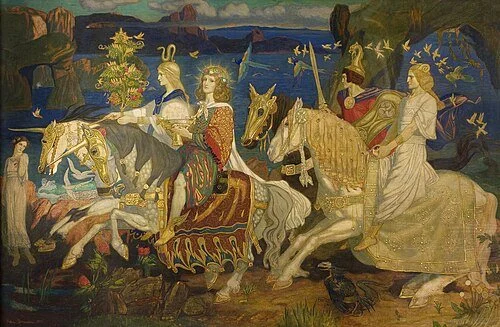
Brigid was a member of the Tuatha Dé Danann and the daughter of the Dagda.
History
Imbolc is a Celtic holiday that was widely celebrated in Scotland and Ireland. The word “imbolc” means ewe’s milk. The traditional shepherds celebrated this time of new life as their sheep gave birth, grass began growing again after cold winters, and the days grew longer.
This ancient festival has been traced to the Neolithic period in Ireland. Archaeological sites have found tombs that align with the sunrise in early February. The Mound of the Hostages dates back to 3350 BCE.
Imbolc occurs during the Celtic Month of Rowan. Rowan symbolizes protection and power. It is governed by the Rowan Tree (Mountain Ash).
As the earth begins to slowly wake up and we see the beginnings of spring, that spark of life is symbolized by a flame. Imbolc is the first of the fire festivals where we celebrate the spark.
Brigid
One of the most popular goddesses with modern day pagans today, Brigid is an old Irish name that translates to ‘exalted one’.
Brigid is fundamentally a fire goddess — but not all fire is the same. She represents three forms of fire. The fire of the forge which symbolizes craft and transformation. Second, the household fire is sacred to Brigid as is the home. At night the woman of the household would bank the fire, so there would be hot embers in the morning, asking for the protection of Brigid as she worked. The third is the fire of inspiration that flame within us. Creative energy. In Irish tradition, poetry was not a casual art — it was a sacred craft wielded by the fillah, a class of professional poets who held significant social and spiritual power.
Brigid is also the guardian of domestic animals and she is said to have two oxen named Fe and Men.
During this holiday it is felt that Brigid visits households and blesses the inhabitants. Leave a door or window open to let Brigid come in!

The Triple Goddess
In Cormac's Glossary a book compiled in the late 800s first references Brigid as a triple goddess. It reads in more modern English:
Brigit — a poetess, daughter of the Dagda. This is Brigit the woman of poetry, a goddess whom poets worshipped, because very great and very famous was her protecting care. Therefore they call her goddess of poets. Her sisters were Brigit the woman of healing and Brigit the woman of smithcraft. Goddesses — among all the Irish, a goddess was called Brigit.
In practice, most modern pagans honor her as one goddess whose nature encompasses all three areas. Modern practitioners view the triple goddess representative of the divine feminine as three distinct archetypes—the Maiden, the Mother, and the Crone. They represent the life cycle (birth, growth, death), the phases of the moon (waxing, full, waning), and feminine empowerment.
As in many traditions the number 3 is important. Threefold beings and groupings appear throughout cultures and include the three realms of land, sea, and sky. Three is understood as a number of completeness and power.
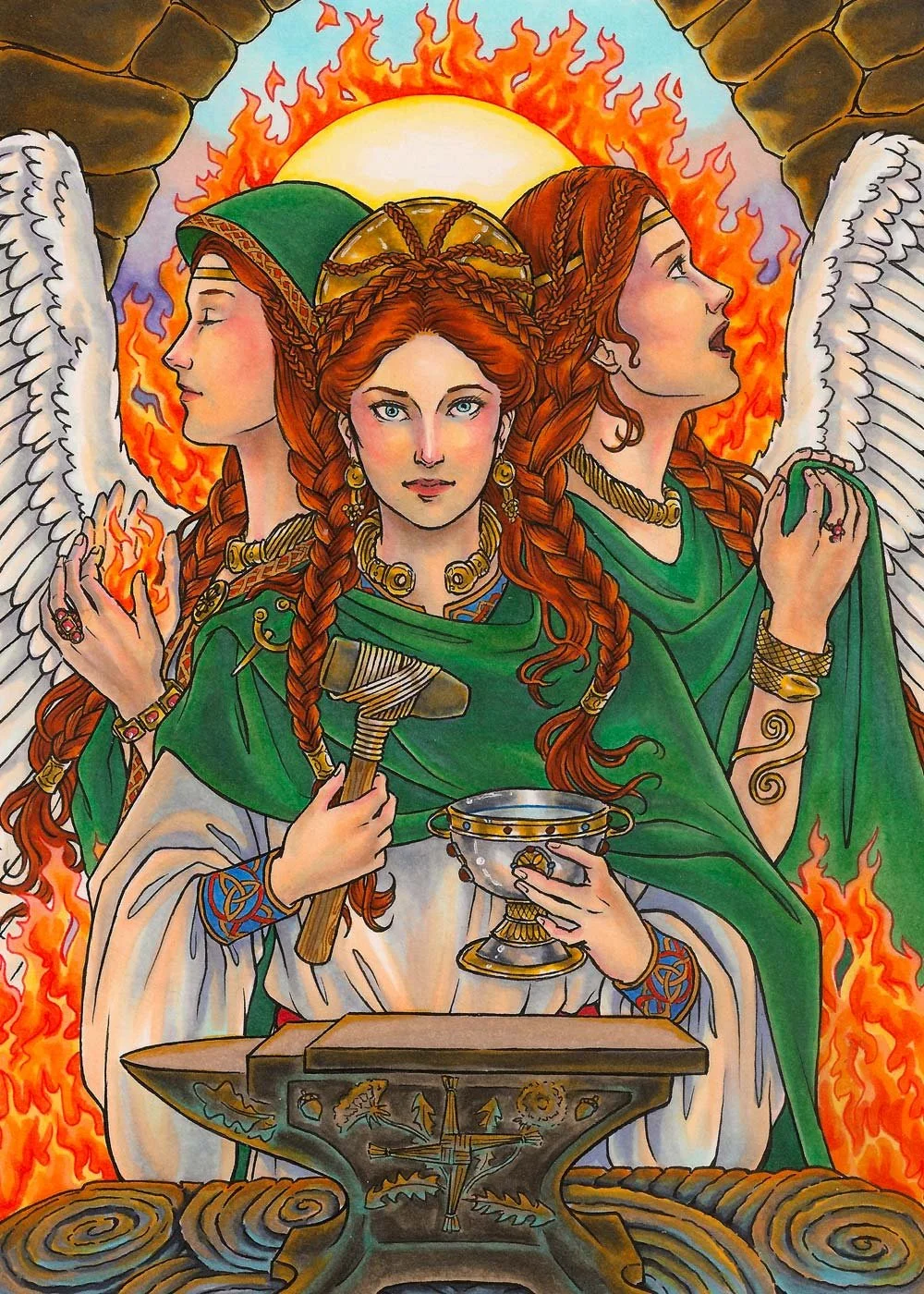
Triple Goddess
Invocation to Brighid
Artist Molly Brewer
Is Candlemas Different Than Imbolc?
Candlemas is the Christian celebration that came from Imbolc. Candlemas starts on the eve of February 1 and ends on the eve of February 2. At this time candles are blessed, and the light honored.
Brigid the goddess was incorporated into the Christian religion. This is referred to as syncretism – the combining and blending of different beliefs. This was a common practice (sadly) to assimilate the pagans into the Christian church. Her feast day and many of her symbols became part of St Brigid.
In Ireland, they celebrate the Feast Day of Saint Brigid. She is referred to as “Muire nan Gael” which means Mary of the Irish. The modern-day Saint Brigid was born 451 in the county of Louth, Ireland. She died in 525 at age 72.
She was known for her acts of charity and feeding the poor. Brigid herself was born a slave and was granted her freedom by the King of Leinster. She went on to become a nun and started several monasteries for women.
Many wells are dedicated to Brigid and the water is considered blessed. Followers visit the wells and offer prayers and coins. They walk in a sunwise direction around the well, say prayers, and ask Brigid for blessings.
Rededication of Tools
Imbolc is a good time to clean and rededicate your ritual tools. Brigid is said to have used a white wand, made of birch, to start plants growing each spring.
Imbolc Altar
There are many things you may wish to include on your Imbolc altar. Choose objects that have spiritual meaning to you and members of your family.
Statue of the goddess Brigid or a corn husk doll to symbolize her. Her colors are considered white for winter and purity and red for the coming sun. Use a white altar cover and red ribbons.
Choose a plant or white flowers, to have at your alter or plant seeds to represent growth. See the candle magic ritual below.
You can add something of Celtic tradition such as Brigid’s crown or cross. Crosses are often woven with straw. Young children can use pipe cleaners.
A chalice filled with water to symbolize her wells or a hammer to represent the smith.
Symbols to add to your altar include white candles, flowers, and seashells.
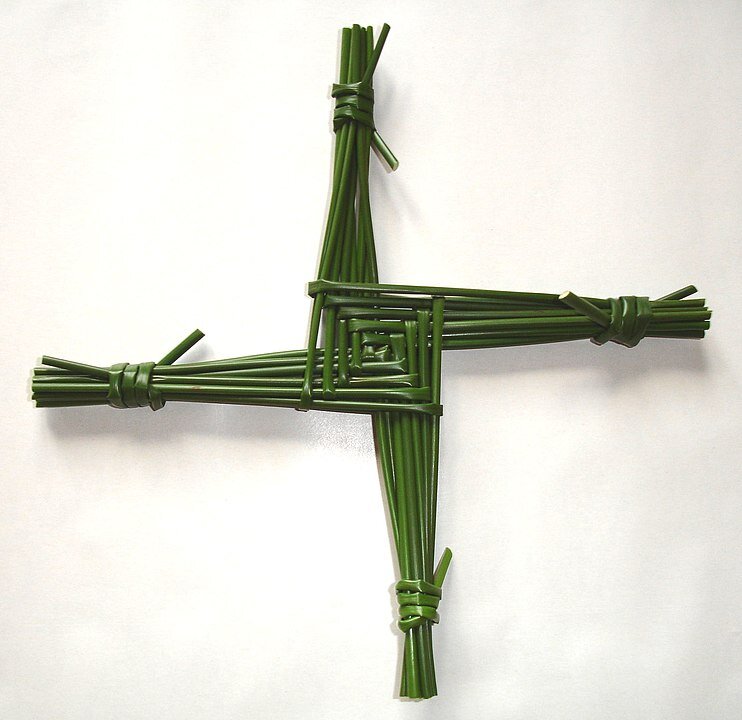
You can make a Brigid’s cross for your altar
How to Make a Brigid's Cross
The Brigid's Cross is one of the oldest and most recognizable symbols associated with Brigid. Traditionally made on Imbolc Eve (January 31st), it is woven from rushes or straw and hung in the home for protection and blessing through the coming year. The classic design features a woven square or diamond at the center with four equal arms extending outward.
Making one is easier than it looks. Once you understand the core folding and rotating motion, it comes together quickly. Set aside about 20–30 minutes your first time.
What You Need
Rushes or straw — fresh rushes are traditional and easiest to work with because they are flexible. Dried straw works too but may need soaking in warm water for 10–15 minutes first to prevent splitting. You need around 16–20 stalks, each at least 12 inches long. Craft stores and garden centers often carry rushes.
For families, pipe cleaners or strips of paper work well for children.
String, twine, or rubber bands — to tie off the four arms at the end
Scissors — to trim the arms to an even length
That is it. No glue, no frame, no special tools required.
A Note Before You Start
The cross is built by a repeated motion: you fold a new rush in half over the center bundle, then rotate the whole thing 90 degrees and repeat. Once you feel the rhythm of it, it moves fast. Read through all the steps once before you begin so the process makes sense as a whole.
Working with rushes: Hold them by the fold end, not the tips. Rushes are tougher at the fold and more likely to split if you grip the cut ends. If a rush splits or breaks, just add a new one and keep going — nobody will notice once it is finished.
Step-by-Step Instructions
Step 1: Start with Your First Rush
Take one rush and fold it in half. Hold it loosely in your non-dominant hand so the folded end (the bend) is at the top and the two loose ends hang down. This folded rush is your starting point — it will become one arm of the cross.
Step 2: Add the Second Rush
Take a second rush and fold it in half. Drape it horizontally over the center of your first rush — right at the fold — so that the bend of the second rush faces to the right and its two loose ends hang to the left. The two rushes should now form a rough plus shape, though they are not locked in yet.
Pinch the center point firmly with your thumb and forefinger. This is the heart of the cross, and keeping it tight is the key to a neat finished product.
Step 3: Rotate and Add the Third Rush
Rotate the whole thing 90 degrees clockwise (or counterclockwise — pick a direction and stick with it throughout).
Fold a third rush in half and drape it over the center the same way you did with the second rush: the folded bend faces right, the loose ends hang left, and you drape it over the top of the center bundle. Pinch tight again.
Step 4: Keep Rotating and Adding
This is the core of the process. Every time you add a rush, you:
Rotate the whole cross 90 degrees in your chosen direction
Fold a new rush in half
Drape it over the center bundle with the bend facing right, loose ends to the left
Pinch the center tightly
Repeat this until your cross feels substantial and the central diamond looks full and even. Most crosses use 12–16 rushes total, but you can keep going until you are happy with how it looks. The center square will build up and tighten as you add more rushes.
Tip: After every few rushes, give the center a firm squeeze to compact it. This keeps the diamond tight and the arms even.
Step 5: Tie Off the Arms
Once the center is as full as you want it, it is time to secure the four arms. Each arm is a bundle of rush ends.
Tie each arm firmly about an inch from the end of the bundle. Use natural twine for a traditional look, or red thread if you want to follow some Irish folk traditions where red was considered protective. Make the ties tight — this is what holds the whole thing together.
Step 6: Trim
Use scissors to trim all four arms to an even length. A finished cross typically has arms about 3–5 inches long from the center diamond. Trimming them evenly gives it a clean, symmetrical look.
Your cross is done.
Troubleshooting Brigid Cross
The center is loose or floppy. You need to pinch tighter while adding each rush, and squeeze the center down after every few additions. Freshness of the rushes matters too — very dry material will not compact as firmly.
The arms are uneven lengths. This is normal your first time. Trimming at the end fixes it. As you practice, you will naturally start adding rushes more evenly.
A rush split or broke. Not a problem. Slide the broken piece out if it is obvious, or just leave it and add a fresh rush in the same position. The finished cross will cover most imperfections.
It does not look like a cross. Make sure you are rotating the same direction every time and draping each new rush the same way. Inconsistent rotation is the most common cause of a lopsided result.
We explore Brigid, a central figure in the Irish pantheon and a popular goddess in modern paganism. This video highlights her connection to the sacred fire of the forge, hearth, and inspiration. Discover more about Goddess Brigid and how you can honor her.
What to Do With It
Hang your finished Brigid's Cross in your home — traditionally above the door, in the kitchen, or near the hearth. The custom is to make a new one each Imbolc and replace the old one. Some people burn the old cross as an offering or return it to the earth. Others keep them, letting the collection build over the years.
If you made it as part of an Imbolc ritual, you can consecrate it before hanging: pass it through incense smoke, hold it to your heart and speak your intention aloud, or place it on your altar overnight before putting it in its permanent spot.
There is no single correct way to do this. The act of making it — the time, attention, and intention you put into it — is itself a devotional act.
Light a Red Candle
Imbolc is a fire festival. As we welcome back the light, we want to also welcome warmth into our lives and homes. Light a red candle on the eve of Imbolc.
Read What Do Candle Colors Represent in Rituals and Spells
Feasting
A special feast was prepared to celebrate with a place and food for Brigid. Traditional foods would have included colcannon, sowans, dumplings, barmbrack, or bannocks.
Colcannon is a dish of mashed potatoes mixed with kale or cabbage.
Sowans is a Scottish porridge made from fermented oats.
Barmback is a quick bread made with wheat flour and raisins.
Bannocks is a flatbread that was popular in Scotland and Ireland. It was also found throughout North America in indigenous diets.
Here is an omnivore recipe for colcannon
Preparing to Plant a Garden
Now is the time to order seeds and plan your garden. Gardening can bring us great joy and children love to watch the growth of their plants. Discussing the natural cycles of life can be a springboard for so many important life lessons.
In addition, as we learned in 2020 food supplies are easily broken. Having a vegetable garden can give you a source of healthy organic fruits and vegetables and food security.
Candle Magic for a Bountiful Garden
What you will need:
Small planting pot filled with soil
White candle and holder
Method:
Light your candle
Face the direction of the earth while holding the candle
Concentrate on what you wish to grow this year – it can be anything. Vegetables for dinner, flowers for beauty, herbs for medicine…
Recite: Brigid my mother bless my dreams, bless my soil, bless the seeds I am about to plant. May my garden grow under your blessed light”.
Place the candle in its holder.
Plant your seed in the pot.
Hold up your planted seed.
Recite: “Thanks be to Brigid”
Spring Cleaning
Maybe you don’t think of spring cleaning as a ritual much less a celebration. However, as we focus on cleansing and purifying ourselves, we need to consider our homes. An organized space helps us to concentrate and allow for the energies to move freely in our homes.
This is a good time for house cleaning. Clean your windows to let the sun in. Remove clutter and things you don’t use. Donate clothes and household goods to charity.
Make and Decorate Candles
A fun family activity is to make your own worship candles. There are many fun kits you can buy to make candles.
The candle’s flame represents fire which we associate with life, passion, and creative energy. They represent the return of the light and the increasing power of the sun.
Women and girls have a long history of tending the fires. St Brigid is associated with the eternal flame. The sacred flame in Kildare was attended by 19 nuns during the middle ages.
Brigid has corresponding goddesses – Vesta from Ancient Rome and Hestia of Ancient Greece were also fire and hearth.
Welcome Brigid
Welcome, Brigid into your home. Set a place for her at the table and prepare a place for her to sleep. In the country of Mann, they would stand outside the home and invite her in “Brede, Brede, come to my house tonight. Open the door for Brede”.
Poetry
Among her other talents, Brigid is the patron of poetry. Read poetry together as a family and discuss how it makes you feel. Remember there are no wrong answers.
Children love poetry. It’s only as we age, we become intimidated by it.
Weather Divination
Many wells and springs are named after Brigid. In Scotland, people watched for snakes and badgers to come out of their dens. Much like the USA Groundhog Day.
Weather is an important event and affects our lives probably in more ways than we acknowledge.
Learn about some signs that tell us about the weather. Did you know that there are many different types of clouds but not all of them produce rain?
Nature Hike
Take a nature walk. If you have snow, ask for a blessing for the warming earth.
Notice what birds are in your area. Are they birds that winter over or birds returning for spring? Look up to see if you see bird nests.
It’s always fun to look for animal tracks in the snow.
The rowan berries are an important winter food source for birds. Plant one in your yard to support wildlife.

Create Jewelry or Metal Art
Smith gods were highly respected by the Celts. Smiths were the master of fire and molded metals into new shapes. Much the way we bring air, fire, water, and earth together to form a new being.
You can celebrate Brigid the Smith by making things out of metal or learning to use tools.
Teach your children how metal hinges work. Join two pieces of wood using a hinge.
Another smith to read about is the Norse God Wayland.
Author, Erik studied Anthropology in college and is currently completing an internship with the Smithsonian Museum of Natural History. Erik desires to be a Viking when he grows up and has worked in Outdoor Adventure leading hikes and rafting trips. A solitary Wiccan, Erik writes about Wicca, Norse religion, and making alters.


Choosing the correct candle colors is essential in witchcraft. Candles are a standard tool used in rituals and spells.
Like all things in magic and witchcraft, the details matter. Everything has symbolism. Understanding color representation helps witches learn how to concentrate their own energy on a task.