
Late summer and early fall carry a particular energy. Backpacks get packed, notebooks get filled, and whether you are five years old or fifty, there is something in the air that says it is time to learn. This season build a relationship with deities of wisdom and knowledge from pagan traditions around the world.
This article covers a wide range of deities of wisdom and knowledge. They are listed in alphabetical order based on culture. Whether you are heading back to a classroom, learning a new skill, or just committing to reading more this year working with a deity can make the experience more meaningful.
Ways to Work With wisdom Deities
Build a small study altar. This may be part of your main altar or a side altar. You may want to place a small end table next to where you study or practice. A candle, a notebook, something that represents your chosen deity, and a small offering dish is enough. Dedicate it to one or two deities whose domains match what you are learning.
Yellow is the color of knowledge. I like beeswax candles because they are eco-friendly.
Start sessions with intention, not just a snack and playlist. A short line spoken to Athena, Thoth, or Saraswati before opening your books turns study time helps you to focus and set an intention.
Offer something back. Study the correspondences of the deity you want to honor and make an offering based on what is important to them. Your offering could be food or drink, jewelry, or something you give of yourself such as singing a song.
Keep a learning journal. Across nearly many traditions, knowledge has been tied to memory and record keeping. A simple journal of what you study and what you struggle with is itself a devotional act. It also helps you to learn and grow on your journey.
americas
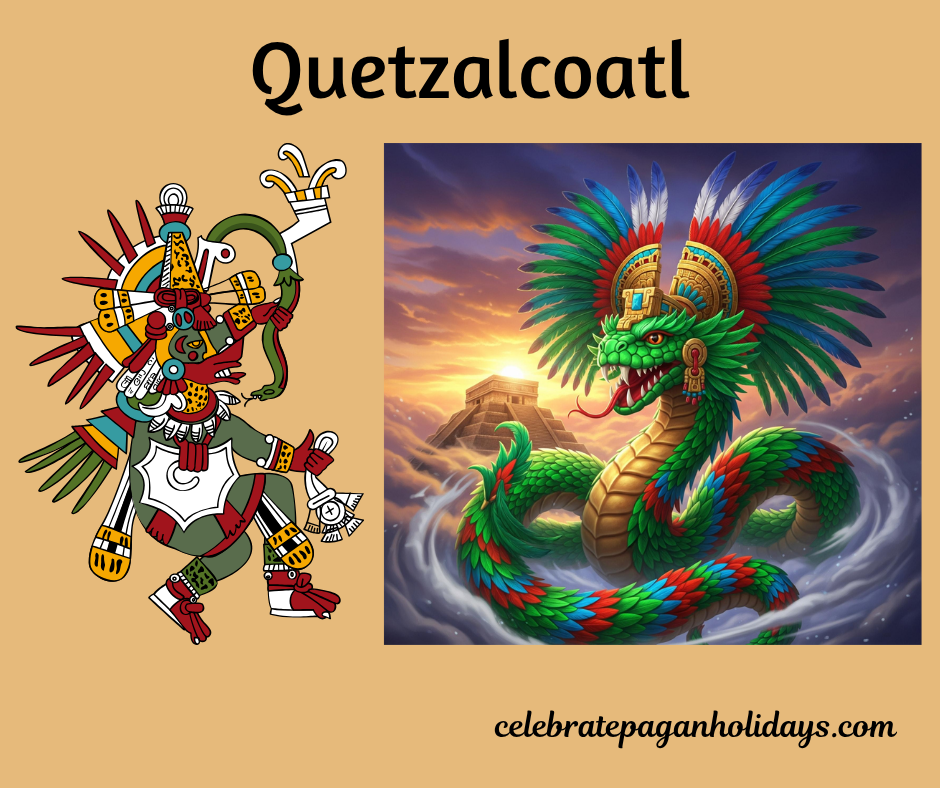
Quetzalcoatl
Quetzalcoatl, the feathered serpent, is honored across Mesoamerica as a god of wind, art, culture, and wisdom, and specifically as a patron of learning and knowledge. He is credited in some traditions with giving humanity maize and the arts, and he is associated with the priesthood and the calendar system, both deeply learned disciplines.
How to honor him: Study calendars, astronomy, or the history of Mesoamerican civilizations. Offer feathers, corn, or cacao.
Pteáŋwiŋ
Pteáŋwiŋ (White Buffalo Calf Woman) is revered as a sacred prophetess and teacher rather than a standard deity. She brought the sacred pipe (čhaŋnúŋpa) and the Seven Sacred Rites to the Lakota in the North American Great Plains. Her instructions form the foundation of Lakota moral living, harmony, and spiritual wisdom.
Honor her with sage, cherry branches, pipes, and by having a good heart and a good mind.
Armenian mythology
Anahit, goddess of wisdom
Anahit, the goddess of fertility and healing, wisdom and water. Her wisdom was practical and compassionate. She guided families and leaders by restoring health, harmony, and societal balance. She is closely related to the Persian goddess Anahita and shares traits with the Greek goddesses Artemis and Aphrodite.
Honor her with roses, doves, and clean water or burn some rose scented incense. Popular Middle Eastern foods such as kheer, a rice pudding flavored with rosewater and cardamom would have been served on her feast day April 11.
“Golden mother,
Woman of roses,
Shower me with petal-soft blessings.
Let my heart open
Like a desert rose
To embrace the love
That comes my way.
May my hands overflow with gold
And may I never forget to share my bounty.”
Tir
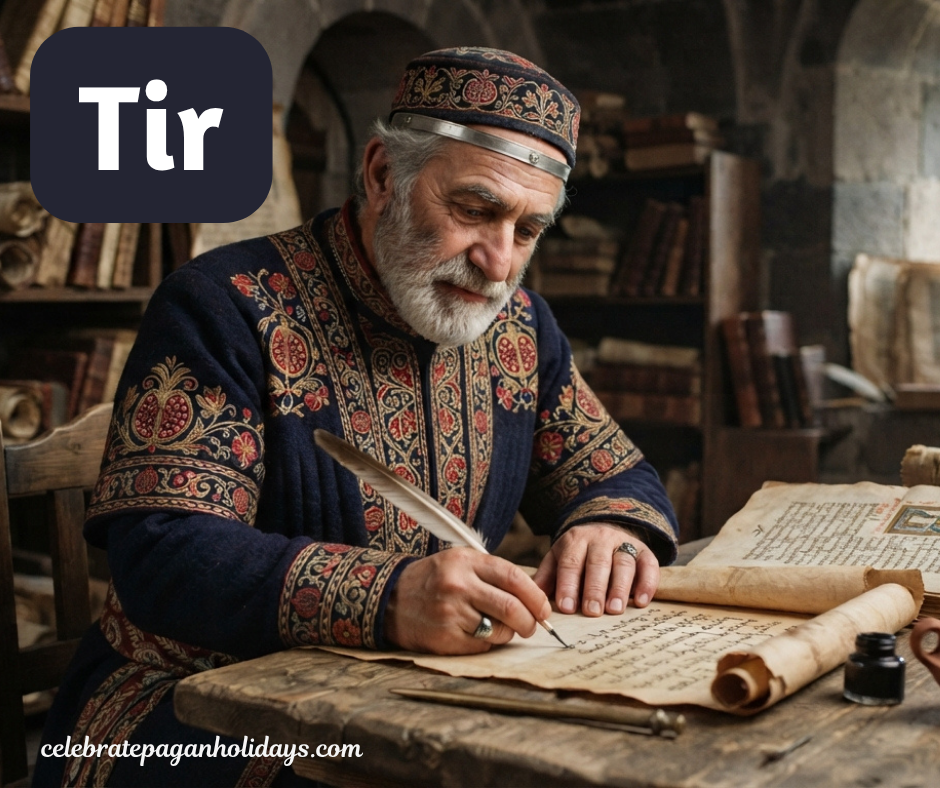
Tir, the Armenian god of written language, schooling, rhetoric, wisdom, and the arts. He was considered to be the scribe and messenger of the chief god Aramazd, as well as a fortune teller and interpreter of dreams, who recorded the good and bad deeds of men. He was also a psychopomp (guide of souls to the underworld).
Priests at his temples functioned as teachers and scholars. They taught youth sciences, astronomy, and cosmography. Armenians identified Tir with the Greek gods Apollo and Hermes. The fourth month of the ancient Armenian calendar was named Trē or Tri in his honor, and several geographic landmarks are named after him.
Honor him with gifts of fine pens, journals, books, and candles or by sharing your studies with him. Tir was connected with honoring our ancestors so you can make an ancestor altar and dedicate it to him. Tir is also a wonderful deity for children and teens because he embraces their learning journey. His Feast Day is September 21
Read my article The Wonder Twins: Apollo and Artemis
Celtic and Irish Deities
Ogma
Ogma, (Irish/Scottish) God of speech, language, literacy, and learning. He is a member of the Tuatha Dé Danann and inventor of the Ogham alphabet, the earliest form of written language in Ireland. He is said to be very eloquent.
Honor him by studying the Ogham alphabet. Write poetry, create a presentation, or read classic literature to sharpen your command of words. Donate books to charity or donate to a non-profit that gives books to children.
Cerridwen
Cerridwen (Welsh): enchantress and goddess of the underworld and transformative knowledge. She is often referred to as the Dark Moon Goddess and Goddess of Inspiration and Death. Cerridwen is the keeper of the magical Cauldron of Inspiration (Awen). She imparts wisdom and knowledge, and intuition.
Honor her with symbols of oak tree, acorns, honeysuckle scents. Place a river stones or moonstone on your altar.
Read my article Cerridwen: Celtic Goddess of the Underworld and Moon
Brigid
Brigid (Celtic) goddess of poetry, smithcraft, and healing. Poetry in the old world was not just art, it was a discipline of memory, law, and history, so Brigid's connection to poets made her a patron of learned people. She is associated with the flame of inspiration as much as the flame of the forge.
How to honor her: Light a candle at your desk while studying. Write poetry or keep a devotional journal. Brigid is a wonderful choice for creative students or anyone learning a hands-on craft.
The Salmon of Knowledge
In Irish myth, a salmon that ate the hazelnuts of wisdom from a sacred river became the Salmon of Knowledge. Whoever ate the salmon would gain all the wisdom in the world. The poet Fintan wanted the knowledge and caught the salmon. He told his young student to cook it but not eat any. Well, as often boys do he didn’t exactly obey his teacher and ate a piece of the salmon. The young boy was named Fionn mac Cumhaill and he who gained wisdom by accident when he tasted the salmon's juices. He became a hero in Gaelic mythology as a warrior, poet, and seer.
How to honor this story: Give an offering of salmon. Spend time near flowing water while thinking through a problem.
Thoth is a powerful deity who can shapeshift into an ibis and baboon. God of wisdom, writing, math, and alchemy he is open to helping us on our pagan path.
Egyptian Deities
Thoth
Thoth is the Egyptian god of the moon, writing, wisdom, and the inventor of language and hieroglyphs. He served as scribe and record keeper to the gods, and in the judgment of the dead, he recorded the results of the weighing of the heart. He is usually depicted as a man with the head of an ibis, sometimes as a baboon. Thoth is a strong choice to call on when you are starting any kind of formal study, writing a paper, or learning a new language.
How to honor him: Keep a journal or notebook dedicated to him where you record what you learn. Offer him ink, paper, or a new pen when starting a big writing project. Study astronomy, math, or a new alphabet in his name.
Seshat
Seshat is Thoth's counterpart, the goddess of writing, measurement, record keeping, and history. She is credited with inventing writing itself and was called upon for surveying, architecture, and astronomy. She is depicted wearing a leopard skin with a star-shaped emblem above her head.
How to honor her: Start a bullet journal, planner, or record of your studies in her name. She is especially fitting for anyone going to school for architecture, math, science, or history.
Check out my Goddess Guide on Bastet
Greek Deities
Athena
Athena is the goddess of wisdom, strategy, and skilled craft. She is honored not just for book knowledge but for practical intelligence, the kind that solves real problems. Students, teachers, engineers, and strategists all fall under her domain.
How to honor her: Offer olive oil or an olive branch. Keep an owl figure on your desk or altar. Before an exam or a big presentation, ask her for clear thinking and steady nerves rather than luck.
Mnemosyne
Mnemosyne is a Titan, the goddess and personification of memory. She is the mother of the nine Muses, which makes her the root source of poetry, history, music, and the arts. If your studies depend on memorization, she is a great deity to learn about.
How to honor her: Light a candle before studying for a test. Practice memory work, like reciting a poem or list from memory, as a devotional act. Children can light a candle to her before studying spelling or vocabulary words.
Norse Deities
Odin
Odin is the Norse god of wisdom, poetry, war, and death. The Allfather seeks and gives wisdom. He hung himself on the World Tree, Yggdrasil, for nine nights to gain the wisdom of the runes, and he gave up one of his eyes for a single drink from the Well of Mimir. He is a god who understands that real wisdom costs something. And he is willing to meet those challenges.
How to honor him: Study the runes. Reflect on what you are willing to sacrifice, in time or comfort, to gain new knowledge this year. Offer mead, honey, beef, and asparagus.
Read my article which has my altar to Odin How to Setup a Norse Pagan Altar ( Complete list of supplies needed )
Mimir
Mimir guards the Well of Wisdom (Mímisbrunnr) at the base of Yggdrasil. His is tied to knowledge and good counsel, and even after his death he continued to advise Odin as a preserved, speaking head. Mimir represents wisdom that comes from deep reflection and consultation.
How to honor him: Sit beside a well, spring, or body of water and journal your thoughts before a big decision. Ask him and Odin for guidance when you feel stuck rather than rushing to an answer.

Slavic Traditions
Veles
Veles is a major god in Slavic mythology tied to magic, cattle, the underworld, and, importantly, wisdom and prophecy. His wisdom comes from understanding the cycle of life, death, and natural renewal. He is often described as a shapeshifting trickster figure who understands hidden knowledge, contrasted with the sky god Perun. Veles is connected to poets, magicians, and those who work with hidden or esoteric knowledge.
How to honor him: Study folklore, mythology, or magical practice in his name. Leave offerings of bread, milk, wild herbs, fresh basil, and snake imagery.
West African and Diasporic Traditions
Orunmila
Orunmila is an Orisha of the Yoruba religion, honored as the deity of wisdom, knowledge, fate, and divination. He is credited with creating the Ifa divination system, an enormous oral corpus of 256 chapters containing poetry, proverbs, and guidance for nearly every life situation. Orunmila is called "witness to fate" and is understood as a deep well of practical and spiritual wisdom. He is honored not only in Yorubaland but throughout the diaspora in traditions like Santeria, Candomble, and Vodou.
How to honor him: Supporting or studying under a Babalawo or Iyanifa, a trained priest or priestess of Ifa,
Late summer and early fall carries back to school energy and whether you are five or fifty, there is something in the air that says it is time to learn. Today I want to talk about forming relationships with deities of wisdom and knowledge.
Why Wisdom Deities
Sitting down to study can feel overwhelming and you may not be able to focus. Acknowledging a deity of wisdom before you start, even with one sentence, marks a clear line between "scrolling" and "working." That small shift in framing makes it easier to actually focus once you begin. It helps to give you a purpose.
Working with a wisdom deity connects you to a long lineage of people who took learning seriously. These deities understand that knowledge is worth real effort, sometimes real sacrifice. Odin gave up an eye. Egyptian scribes trained for years under Thoth and Seshat's patronage. When you call on these deities, you are stepping into that lineage rather than treating your homework or your practice as something that is isolated.
It offers comfort and humility. Calling on Athena for clear thinking before a test, or Mnemosyne before memorizing something dense, gives you a place to put anxiety. At the same time, treating knowledge as sacred keeps you humble about how much there still is to learn, which is a healthy posture for anyone in a classroom or learning a new skill.
For many pagans, it develops into a genuine relationship, one where the deity is a real presence they are building rapport with over years, not just a study aid. The more you work with a deity the more you get to know them, and they you.
Author, Ame is the founder of Celebrate Pagan Holidays. You can learn more about us here.


Altars are a focal point for many religions. A place of sacred space. Creating an altar is one way for you to create and invite magic into your home.
For pagans, an altar is a place in your home where you will practice your religion. It is a place where you can connect with higher powers. Your alter is a living thing that enhances your spiritual walk.