
Ancient Egyptian death was a journey that started before the person died. Preparation for death as well as the rites and process of the body were critical. In Abrahamic religions the soul is often viewed as one, spiritual core and the part of the person that exists independently of the physical body after death. The ancient Egyptian and Kemetic view of the soul is very different. So today we are going to break that down.
Ancient Egyptians had a complex view of the soul, which was composed of nine distinct parts. These are referenced in ancient funerary texts. Funerary texts are writings of religious spells, prayers, and instructions to help the deceased safely navigate and reach the afterlife.
The Khet is the physical body
We are going to talk about each one.
Khet
Ka
Shuyet
Ib
Ba
Sah
Sekhem
Ren
Akh
I have the parts listed in the Common Hierarchical Order from densest to cosmic but there is no absolute order for you to study them in. I do highly recommend getting a copy of the Book of the Dead if you are interested in the Egyptian afterlife.
Read my blog Book Of The Dead: Spells and Guide For Ancient Egyptian Afterlife
Khet (physical body)
The Khet is the physical body, the flesh and bones a person occupies in life. The body is the container for the soul. This belief was the reason for the development of mummification. It's necessary for the body to be preserved as efficiently and completely as possible so it remains that vessel.
If you were killed in battle a suitable substitute like a statue could be used so that the other elements of the soul had a stable place to return to.
Ka (vital essence)
The Ka is a person's life force, the energy that animates the body and distinguishes a living person from a corpse. The Ka came into being alongside the physical body, sometimes described as formed by the god Khnum on a potter's wheel. The Ka takes the form of two upright arms.
The Ka is what made the new infant truly alive. The Egyptians believed that either the fertility goddess Heqet or the childbirth goddess Meskhenet breathed the Ka into a body at the time of birth.
The Ka still needs nourishment after death. After a person has died, offerings would still be made at their resting place.
Death occurs when a person's ka leaves the body.
Ceremonies conducted by priests before the mummy entered the tomb, including the "opening of the mouth aimed to restore a person's physical abilities in death
Check out my Etsy Shop!
Shuyet (The Shadow)
Ancient Egyptians believed the shadow was a part of a person’s soul. It was ever present, and contained a part of what makes each individual unique. The Shuyet is a person's shadow. It was thought to hold something of the person's essence, since a person can not exist without a shadow, and a shadow can not exist without a person.
The Shuyet was often depicted as a small, solid black human figure that continued to exist after death. In the Book of the Dead, their are prayers like this one and spells so the deceased doesnt lose their Shuyet. To lose one’s shadow was to lose a part of one’s being, a kind of spiritual amputation.
The Shuyet was believed to be a servant to Anubis, the Egyptian god of death and the afterlife. Physical depictions of the Shuyet were of a human figure shaded entirely black.
Read my blog Honoring Anubis: God of the Afterlife and Transitions
Some tombs had a ‘Shadow Box’ among their funerary items so that the Shuyet had a place to inhabit.
In the Egyptian Book of the Dead the soul is described as leaving the tomb of the deceased during the day in the form of a shadow and returning at night.
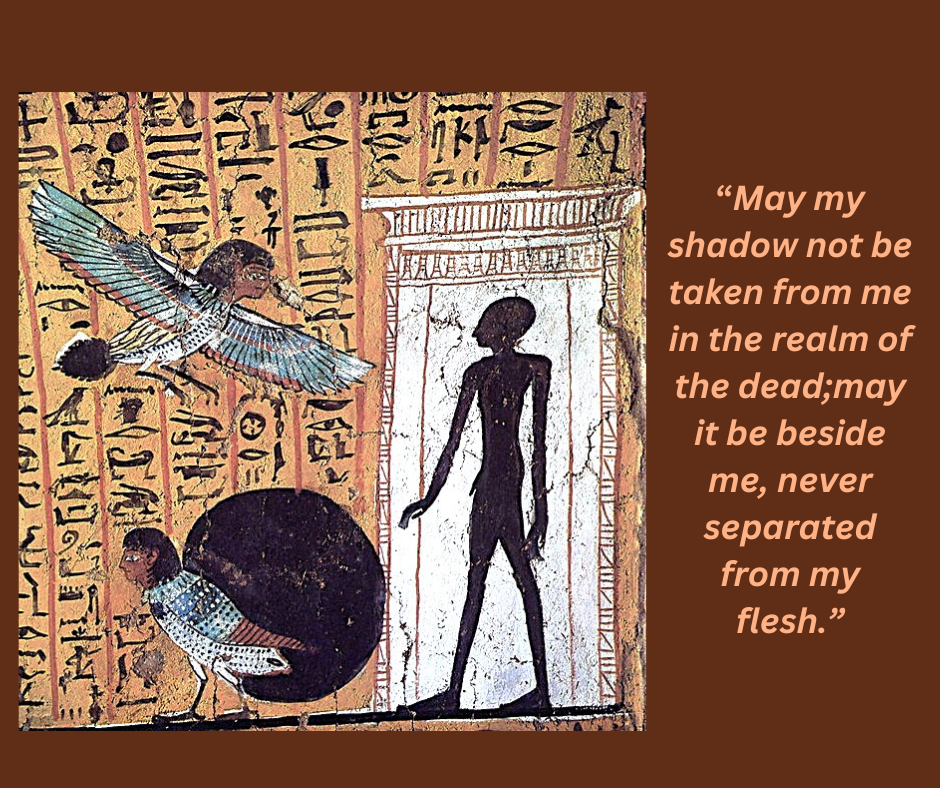
The Ba with the Shuyet
Ib (the Heart)
The Ib is the heart, and in Egyptian beliefs it is where thought, emotion, intention, and memory, are located. The Ib was left inside the body during mummification, unlike the brain which was removed. Ancient Egyptians would encourage each other to follow your heart. We continue to say that and its one reason I started this channel.
The weighing of the heart is a critical stage in the journey to the afterlife. The heart was weighed against the feather of Ma'at and determined whether a person's actions and character in life were in balance with truth and order. Anubis placed the dead person's heart on the scale If the heart balanced evenly with the feather, or was lighter, the person had lived a good life. They were then presented to the god Osiris and allowed to enter paradise in the Field of Rushes
If bad deeds made the heart heavy, it tipped the scale down and Ammit immediately devoured the heart. This meant the end of the soul. It is important to remember that Ammit is an enforcer. She does not judge but provides balance.
Many Egyptian deities carry this symbol. The Ankh. It represents life, physical life on Earth, eternal existence, and the afterlife. I have a video on ways you can use it in your practice.
The Ankh, the key of life. Perhaps the most well-known Egyptian symbol. This video is a deep dive into what the ankh symbol meant to the ancient Egyptians, what it is to us today, and various ways we can use the Ankh in our spiritual and magical practices.
Ba (personality)
So moving on. The Ba. In todays world we would view the Ba as our personality. Everything that makes us unique. The Ba is the way the soul moves between the mortal realm and the spiritual one. Ba is represented as a bird with a human head.
During the day, the Ba was free to leave the tomb and travel. Each night, the soul had to return to the tomb. Egyptians believed the Ba occasionally traveled while a person was still alive, but that the journey the Ba made between worlds increased significantly after death.
The Ba can detach from the physical body and temporarily travel between the mortal realm and the spiritual realm. This movement often explains vivid dreams or out-of-body experiences. Today we often refer to it as astral projection.
Sah (spiritual body)
The Sah is the transfigured, spiritual body that a person could take on after death, once the proper burial rites and mummification were completed. It functioned as a bridge between the physical Khet and the fully spiritual state a person entered in the afterlife. The Sah allowed a person to move, act, and exist among the gods and other transfigured beings.
Sekhem (personal power)
The Sekhem is a person's power or force, particularly the vital strength that could be drawn on in the afterlife. It's closely related to the Ka but refers more specifically to the energy or capability a person had access to, rather than simply the fact of being alive.
Sekhem and Sah are attested as real terms in Coffin Texts and Book of the Dead material, though less frequently discussed on their own compared to ka, ba, and ib. Sekhem also shows up outside of soul-context entirely, as a divine title and the name of a ceremonial scepter.
The sekhem became fully active and manifested among the gods in the afterlife after a person passed final judgment. The concept is closely linked to the fierce lioness goddess Sekhmet, whose name shares the same root and who channels this raw, transformative energy for healing and protection.
Ren (name, identity)
Ancient Egyptians were given a name at birth which was kept secret to everyone but the gods. This name was considered an extremely important and powerful part of the soul. The Ren is a person's true name. Names were treated as a real and active part of a person's identity, not just a label. As long as a person's Ren was spoken or written, that person continued to exist in some form.
Erasing someone's name from a monument was treated as an act of destruction against the person, not just their memory. We see that happening throughout Egyptian history.
Egyptian queen Hatshepsut—had many of her statues destroyed by her stepson and successor Thutmose III, during a smear campaign leveled against the queen after her death.
AKH
The Akh is the transfigured, glorious, and luminous spirit of a deceased person. It is not a part you are born with; it is the final, immortal state achieved after death. It forms when Ka and Ba successfully reunite after the deceased passes the judgment of the heart in the afterlife.